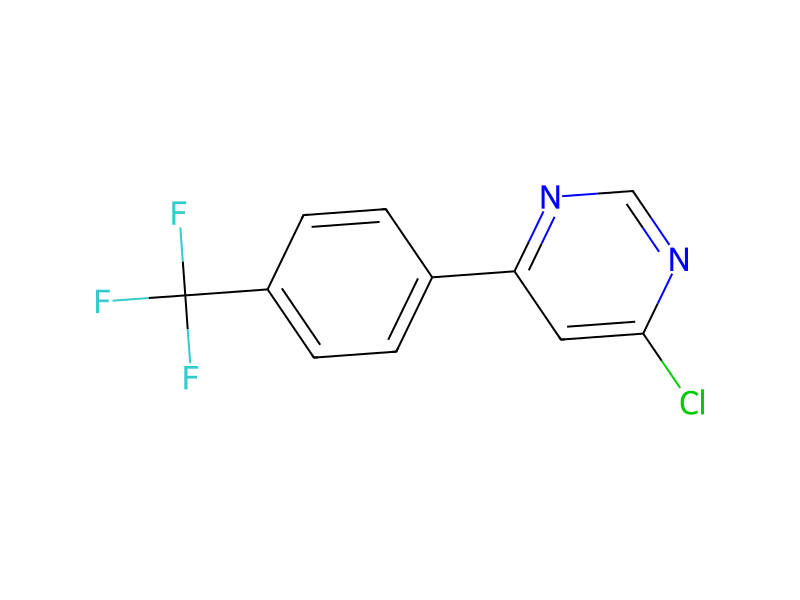
Cl[C:2]1[CH:7]=[C:6]([C:8]2[CH:13]=[CH:12][C:11]([C:14]([F:17])([F:16])[F:15])=[CH:10][CH:9]=2)[N:5]=[CH:4][N:3]=1.[CH3:18][C:19]1[CH:20]=[N:21][C:22]2[CH:23]=[CH:24][CH:25]=[C:26]([OH:29])[C:27]=2[N:28]=1.[H-].[Na+]>CN(C=O)C>[CH3:18][C:19]1[CH:20]=[N:21][C:22]2[C:27](=[C:26]([O:29][C:2]3[CH:7]=[C:6]([C:8]4[CH:13]=[CH:12][C:11]([C:14]([F:17])([F:16])[F:15])=[CH:10][CH:9]=4)[N:5]=[CH:4][N:3]=3)[CH:25]=[CH:24][CH:23]=2)[N:28]=1To a mixture of 4-chloro-6-(4-trifluoromethyl-phenyl)-pyrimidine, (Example 2(a), Method A), (0.20 g, 0.77 mmol) and 3-methyl-quinoxalin-5-ol (0.14 g, 0.85 mmol, prepared according to J. Med. Chem. 1988, 41, 4062-4079.) in DMF (3 mL) was added sodium hydride (0.040 g, 1.0 mmol, 60% dispersion in mineral oil, Aldrich). The reaction was heated at 60° C. for 24 h, allowed to cool to room temperature and partitioned between EtOAc and H2O. The aqueous layer was extracted with EtOAc (4 x). The combined organic layers were dried over MgSO4, filtered and the solvent was removed in vacuum. The residue was purified by flash chromatography (0→75% EtOAc/hexanes) to give the title compound as an ivory powder. Mp: 139-141° C., MS (ESI, pos. ion) m/z: 383 (M+1).
Wird geladen…