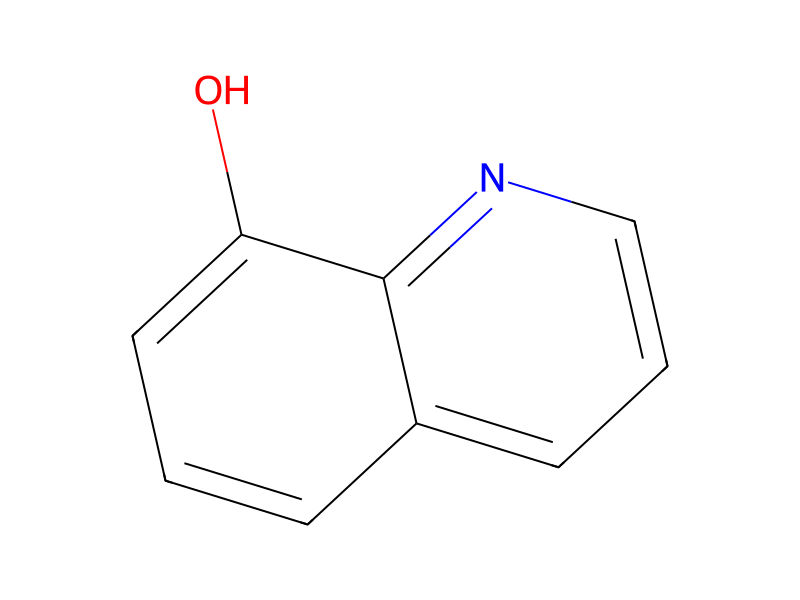
[OH:1][C:2]1[CH:3]=[CH:4][CH:5]=[C:6]2[C:11]=1[N:10]=[CH:9][CH:8]=[CH:7]2.[OH-].[Na+].[I-].[K+].[CH:16](Cl)=[CH:17][CH2:18][CH2:19][CH2:20][CH2:21][CH2:22][CH2:23][CH2:24][CH2:25][CH2:26][CH3:27]>CO>[CH:16]([C:3]1[C:2]([OH:1])=[C:11]2[C:6]([CH:7]=[CH:8][CH:9]=[N:10]2)=[CH:5][CH:4]=1)=[CH:17][CH2:18][CH2:19][CH2:20][CH2:21][CH2:22][CH2:23][CH2:24][CH2:25][CH2:26][CH3:27]One hundred forty five grams (1.0 mole) 8-hydroxyquinoline, 40 gm. sodium hydroxide, 500 ml. methanol and 5 gm. potassium iodide were combined in a two liter round bottom flask. To this was added 243 gm. dodecenyl chloride (as used in Example I) and the mixture stirred under reflux overnight. The product was filtered, taken up in ether and washed with 500 ml. Claisen's alkali (in five portions). The ether solution was washed several times with water until neutral, dried and the solvent stripped to yield 317.9 gm. of crude product. Of this amount, 310.9 gm. was distilled through a one foot Vigreaux after being heated in the pot to 230° C. and cooled to about 100° C. The fractions coming off at 197°-202° C., 0.7 mm. Hg. (51.1 gm.) and 202°-231° C., 0.8 mm. Hg. (96.8 gm.) consisted almost entirely of 7-dodecenyl-8-hydroxyquinoline.