StartseiteMCPWorkbenchSkills
StartseiteWorkbenchBenachrichtigungenMein Bereich
llms.txt · MCP-AnleitungDatenschutz · Nutzungsbedingungen · Supportv1.8.0
  1. Startseite
  2. /Reaktion

Hydrochloric Acid → 1-(7-Bromoquinolin-2-yl)ethanone

HRID 2176212
Notizen
Druckvorschau

Reaktionsgleichung

Reaktionsgleichung von HRID 2176212
[Br:1][C:2]1[CH:11]=[C:10]2[C:5]([CH:6]=[CH:7][C:8](I)=[N:9]2)=[CH:4][CH:3]=1.C([Sn](CCCC)(CCCC)[C:18]([O:20]CC)=[CH2:19])CCC.Cl>Cl[Pd](Cl)([P](C1C=CC=CC=1)(C1C=CC=CC=1)C1C=CC=CC=1)[P](C1C=CC=CC=1)(C1C=CC=CC=1)C1C=CC=CC=1.O1CCOCC1>[Br:1][C:2]1[CH:11]=[C:10]2[C:5]([CH:6]=[CH:7][C:8]([C:18](=[O:20])[CH3:19])=[N:9]2)=[CH:4][CH:3]=1
KomponentenReaktionsbedingungenVersuchsvorschriftAufarbeitungQuellen und NachweiseNotizen zur Reaktion

Komponenten

6

Edukt 3

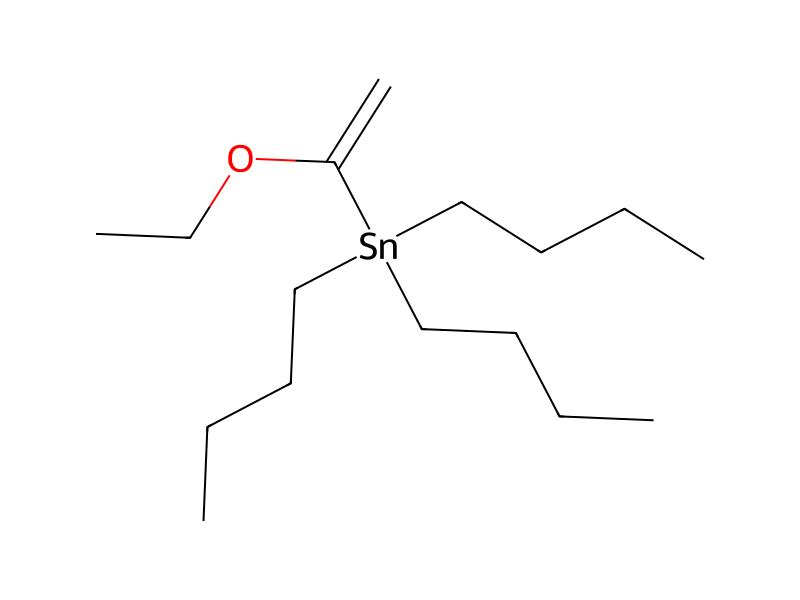
HCID 313Hydrochloric AcidHCID 619414Stannane, tributyl(1-ethoxyethenyl)-HCID 867060267-Bromo-2-iodoquinoline

Produkt 1

HCID 867060471-(7-Bromoquinolin-2-yl)ethanoneAusbeute 66 %

Reagenzien, Katalysatoren, Lösungsmittel 2

HCID 178418476HCID 178418476, VerbindungKatalysator
HCID 31275
1,4-Dioxane
Lösungsmittel

Reaktionsbedingungen

Temperatur
100 °C

Versuchsvorschrift

To a stirred slurry of 7-bromo-2-chloro-quinoline (obtained from AstaTech, Inc.), (8.10 g, 33.4 mmol) and sodium iodide (50.0 g, 334 mmol) in acetonitrile (27 mL) was slowly added acetyl chloride (3.56 mL, 50.0 mmol). The flask was stoppered and sealed and heated at 80° C. for 3 h before being allowed to cool. The mixture was treated sequentially with 10% w/w aqueous potassium carbonate solution (80 mL), 5% w/w aqueous sodium sulfite solution (80 mL) and saturated aqueous sodium thiosulfate solution (80 mL) and the mixture extracted with dichloromethane (2×). The combined organic extracts were dried over sodium sulfate, filtered and evaporated to give a crude 7-bromo-2-iodo-quinoline. To the quinoline was added tributyl(1-ethoxyvinyl)tin (13.6 mL, 40.1 mmol), 1,4-dioxane (67 mL) and bis(triphenylphosphine)palladium(II) dichloride (2.37 g, 3.34 mmol) and the reaction mixture heated at 100° C. for 5 h before being allowed to cool. 2 M aqueous hydrochloric acid (67 mL) was added and the reaction stirred for 1 h. The mixture was filtered and the solids washed with ethyl acetate and the filtrate evaporated to remove organics. The residue was extracted with ethyl acetate (3×) and the combined organic extracts were dried over sodium sulfate, filtered and evaporated. The product was purified on silica gel doped with 10% w/w potassium carbonate eluting with a gradient of 0% to 6% ethyl acetate in iso-hexanes to afford the title compound (5.5 g, 66%) as a white solid. 1H NMR (300 MHz, CDCl3) δ 2.86 (s, 3H), 7.72-7.80 (m, 2H), 8.21 (ABq, ΔδAB=0.11, JAB=8.5 Hz, 2H), 8.42 (s, 1H). LCMS (m/z) 250.1/252.1 [M+H], Tr=2.90 min.


Aufarbeitung

  1. temperatureto cool
  2. filtrationThe mixture was filtered
  3. washthe solids washed with ethyl acetate
  4. customthe filtrate evaporated
  5. customto remove organics
  6. extractionThe residue was extracted with ethyl acetate (3×)
  7. dry with materialthe combined organic extracts were dried over sodium sulfate
  8. filtrationfiltered
  9. customevaporated
  10. customThe product was purified on silica gel

Quellen und Nachweise

ORD-Eintrag
ord-2db5578c30bb4960ab86a9f2433ba8c8
Quelldatensatz
uspto-grants-2015_06
DOI
10.6084/m9.figshare.5104873.v1
Patentnummer
US09062092B2

Notizen zur Reaktion

Wird geladen…

Auf dieser SeiteKomponentenReaktionsbedingungenVersuchsvorschriftAufarbeitungQuellen und NachweiseNotizen zur Reaktion