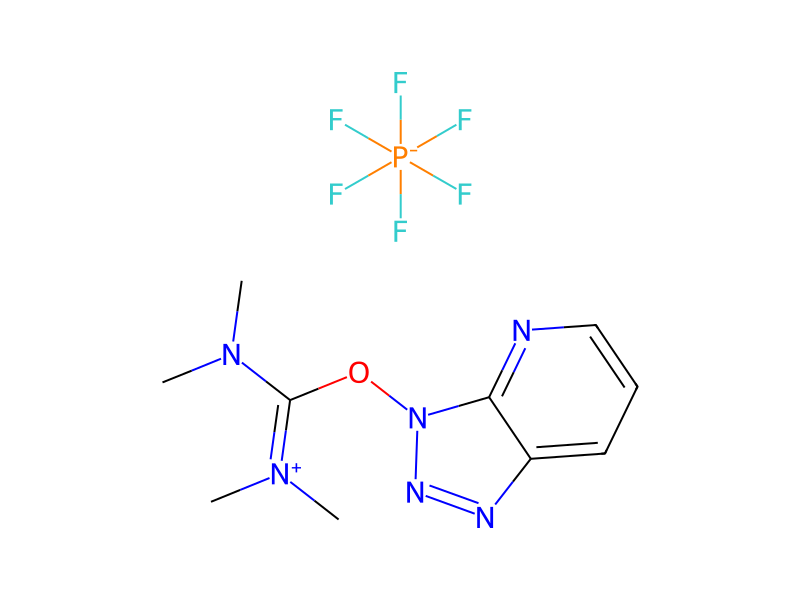
[CH3:1][C:2]1[CH:11]=[CH:10][C:9]2[C:4](=[CH:5][CH:6]=[C:7]([C:12]([OH:14])=O)[CH:8]=2)[N:3]=1.CN(C(ON1N=NC2C=CC=NC1=2)=[N+](C)C)C.F[P-](F)(F)(F)(F)F.[NH2:39][CH2:40][C@H:41]([OH:53])[CH2:42][N:43]1[CH2:52][CH2:51][C:50]2[C:45](=[CH:46][CH:47]=[CH:48][CH:49]=2)[CH2:44]1>C(Cl)Cl>[CH2:44]1[C:45]2[C:50](=[CH:49][CH:48]=[CH:47][CH:46]=2)[CH2:51][CH2:52][N:43]1[CH2:42][C@@H:41]([OH:53])[CH2:40][NH:39][C:12]([C:7]1[CH:8]=[C:9]2[C:4](=[CH:5][CH:6]=1)[N:3]=[C:2]([CH3:1])[CH:11]=[CH:10]2)=[O:14]To a solution of 2-methylquinoline-6-carboxylic acid (1 g, 5.35 mmol) in DCM (100 mL), was added HATU (2.44 g, 6.42 mmol) and TEA (1620 mg, 16.043 mmol). The solution was stirred at 15° C. for 30 minutes before (S)-1-amino-3-(3,4-dihydro isoquinolin-2(1H)-yl)propan-2-ol (1.76 g, 8.55 mmol) was added. The resulting solution was stirred for 16 h at 15° C. until LCMS analysis showed the reaction to be complete. The mixture was then concentrated under vacuum and the residue purified by Preparative HPLC to give the desired title compound (502.1 mg, 25%). 1H NMR (400 MHz, METHANOL-d4) δ 8.31 (br. s., 1H), 8.08 (d, J=8.8 Hz, 1H), 8.12 (d, J=8.4 Hz, 1H), 7.91 (d, J=8.8 Hz, 1H), 7.47 (d, J=8.3 Hz, 1H), 7.17-7.03 (m, 4H), 4.23-4.11 (m, 1H), 3.78 (br. s., 2H), 3.59 (d, J=5.5 Hz, 2H), 2.91 (br. s., 4H), 2.78-2.69 (m, 5H). LCMS (m/z): 376.1 [M+H]+.