StartseiteMCPWorkbenchSkills
StartseiteWorkbenchBenachrichtigungenMein Bereich
llms.txt · MCP-AnleitungDatenschutz · Nutzungsbedingungen · Supportv1.8.1
  1. Startseite
  2. /Reaktion

Benzoylacetone → 2-(Dimethyl-amino)-1-phenyl-1,3-butanediene

HRID 22280
Drucken

Reaktionsgleichung

Reaktionsgleichung von HRID 22280
[C:1]([CH2:9][C:10]([CH3:12])=O)(=O)[C:2]1[CH:7]=[CH:6][CH:5]=[CH:4][CH:3]=1.CO[CH:15](OC)[N:16](C)[CH3:17]>>[CH3:15][N:16]([CH3:17])[C:9]([CH:10]=[CH2:12])=[CH:1][C:2]1[CH:7]=[CH:6][CH:5]=[CH:4][CH:3]=1
KomponentenVersuchsvorschriftAufarbeitungQuellen und NachweiseNotizen zur Reaktion

Komponenten

3

Edukt 2

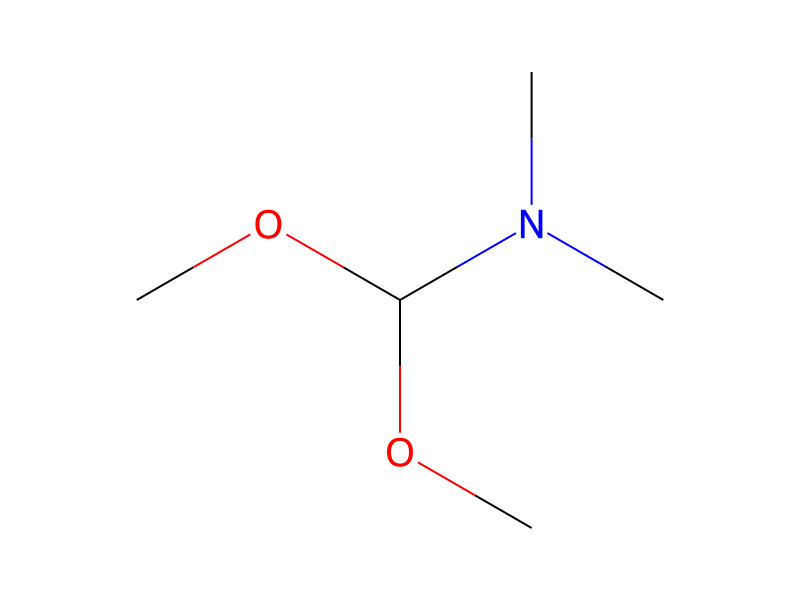
HCID 7166BenzoylacetoneHCID 78373Dimethylformamide dimethyl acetal

Produkt 1

HCID 540903252-(Dimethyl-amino)-1-phenyl-1,3-butanedieneAusbeute 78 %

Versuchsvorschrift

A mixture of 1-benzoylacetone (24.00 g, 0.15 mole) and dimethylformamide dimethylacetal were stirred overnight at room temperature under argon. The resulting reddish-colored mixture was concentrated on the rotary evaporator, then dissolved in THF (tetrahydrofuran). The resulting solution was stirred and heated to boiling and slowly diluted with hexane. At the point of turbidity heating was discontinued. An orange gum precipitated and rapidly solidified. The mixture was chilled in an ice bath and filtered yielding 25.25 g (78%) of 2-(dimethyl-amino)-1-phenyl-1,3-butanediene m.pt. 72°-74° C.

Aufarbeitung

  1. concentrationThe resulting reddish-colored mixture was concentrated on the rotary evaporator
  • dissolutiondissolved in THF (tetrahydrofuran)
  • stirringThe resulting solution was stirred
  • temperatureheated
  • additionslowly diluted with hexane
  • temperatureAt the point of turbidity heating
  • customAn orange gum precipitated
  • temperatureThe mixture was chilled in an ice bath
  • filtrationfiltered
  • Quellen und Nachweise

    ORD-Eintrag
    ord-5f965f4e8b9a40e38f34af36522c9be1
    Quelldatensatz
    uspto-grants-1995_06
    DOI
    10.6084/m9.figshare.5104873.v1
    Patentnummer
    US05428045

    Notizen zur Reaktion

    Auf dieser SeiteKomponentenVersuchsvorschriftAufarbeitungQuellen und NachweiseNotizen zur Reaktion