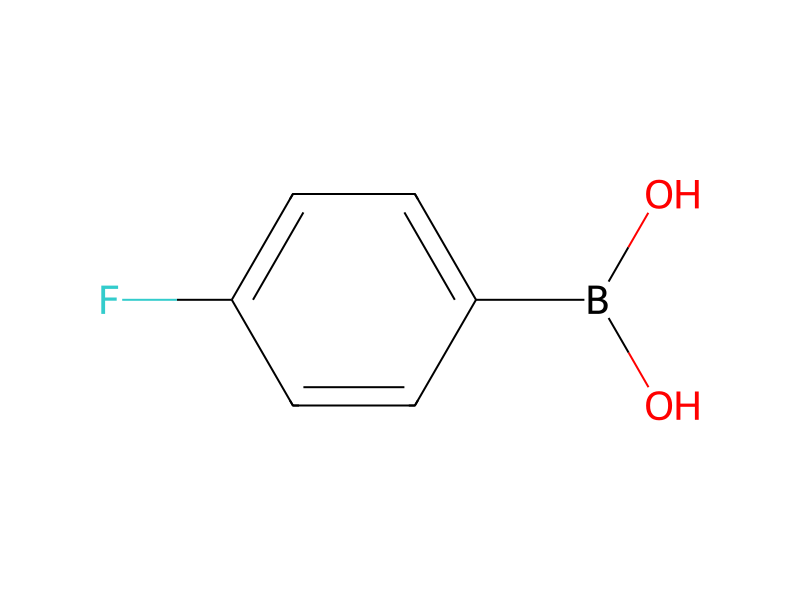
[F:1][C:2]1[CH:7]=[CH:6][C:5](B(O)O)=[CH:4][CH:3]=1.[CH2:11]([O:18][C:19]1[CH:24]=[C:23]([O:25][CH2:26][CH2:27][CH2:28][C:29]#[N:30])[C:22]([CH2:31][CH3:32])=[CH:21][C:20]=1Br)[C:12]1[CH:17]=[CH:16][CH:15]=[CH:14][CH:13]=1.C1(C)C=CC=CC=1.C(=O)([O-])[O-].[Na+].[Na+]>C(O)C.C(OCC)(=O)C>[CH2:11]([O:18][C:19]1[CH:24]=[C:23]([O:25][CH2:26][CH2:27][CH2:28][C:29]#[N:30])[C:22]([CH2:31][CH3:32])=[CH:21][C:20]=1[C:5]1[CH:6]=[CH:7][C:2]([F:1])=[CH:3][CH:4]=1)[C:12]1[CH:13]=[CH:14][CH:15]=[CH:16][CH:17]=14-fluorobenzene boronic acid (1.14 g) was dissolved in ethanol (7 mL). To this was added 1-(benzyloxy)-2-bromo-4-ethyl-5-[(3-cyanopropyl)oxy]-benzene (1.5 g), toluene (20 mL), tetrakis-triphenylphosphine palladium (470 mg), and 2M sodium carbonate solution (6.1 mL). The resulting mixture was heated to reflux and held there for 24 hours. The solution was cooled, diluted with ethyl acetate, and the layers separated. The organic layer was washed with saturated ammonium chloride, dried over magnesium sulfate, filtered, and concentrated to afford a green oil. This was purified by flash chromatography on silica using hexane/ethyl acetate (9:1). The resulting fractions were concentrated under vacuum to afford 1-Benzyloxy-2-(4-fluorophenyl)-4-ethyl-5-[(3-cyanopropyl)oxy]-benzene (1.1 g) as a clear oil. NMR (CDCl3): 1.18, t (3H); 2.15, m (2H); 2.59, m (4 H); 4.06, t (2H); 5.00, s (2H); 6.53, s (1H); 7.06, t (2H); 7.09, s (1H); 7.30, m (5H); 7.49, d of d (2H). Mass Spec (EI), m/e=412.2 (M+Na).
Wird geladen…