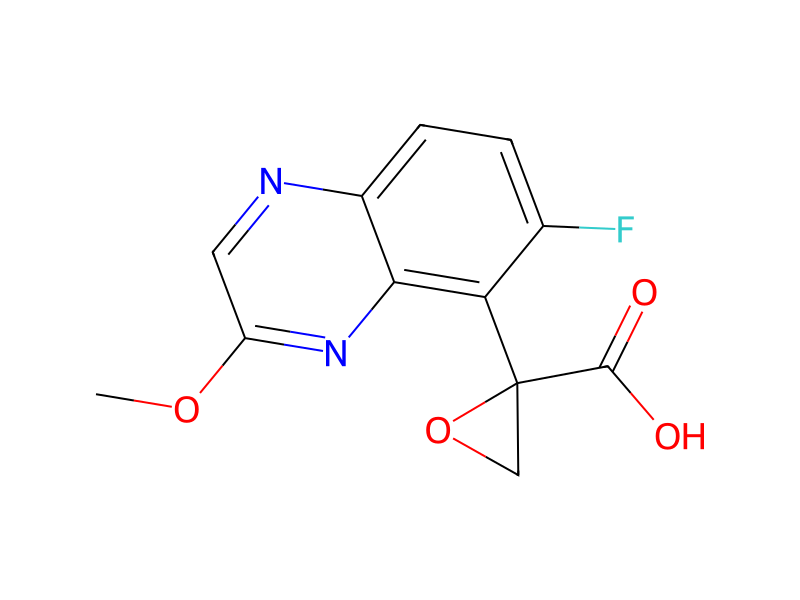
A solution of methyl 2-[6-fluoro-3-(methyloxy)-5-quinoxalinyl]-2-propenoate (5.45 g, 0.02 mol) (for a preparation, see Example 1(l)) in THF (150 ml) was cooled to 0° C. A 6M solution tert-butyl hydrogen peroxide in nonane (5.2 mL, 0.03 mol) was added dropwise followed by a 1M solution of potassium tert-butoxide (10.39 mL, 0.01 mol). During the addition the temperature was kept at 0° C. The reaction mixture was kept at 0° C. for 16 hours. Another 0.5 equivalent of the 1M solution of potassium tert-butoxide (10.39 mL, 0.01 mol) was added at 0° C. and the reaction mixture was kept for a further 2 hours. The reaction was quenched by addition of a 1M solution of HCl in methanol (20 mL). The reaction mixture was evaporated to dryness. The residue was partially dissolved in methanol. The organic layer was dried over magnesium sulphate, filtered, evaporated under vacuum and chromatographed on silica (required repeated chromatography), eluting with a 0-30% methanol in dichloromethane gradient to afford the product as a white solid (3.22 g, 59%)