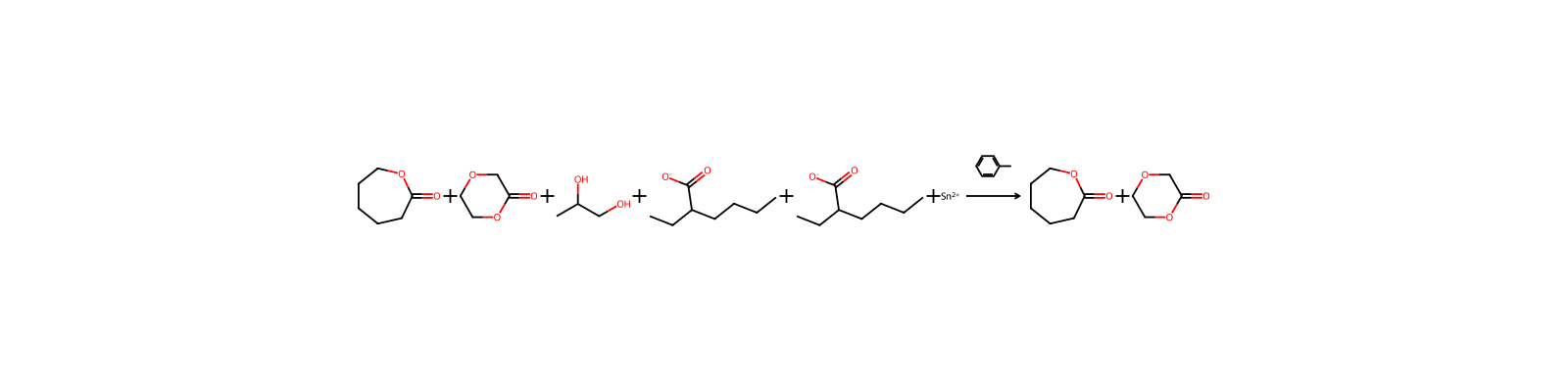
Beteiligte Stoffe
| Rolle | Name | HCID | Einwaage |
|---|
| Edukt | Propylene Glycol | HCID 1030 | — |
| Edukt | 2-ethylhexanoic acid tin(II) salt | HCID 9318 | — |
| Edukt | epsilon-CAPROLACTONE | HCID 10401 | — |
| Edukt | Dioxanone | HCID 18233 | — |
| Lösungsmittel | Toluene | HCID 1140 | — |
| Produkt | epsilon-Caprolactone p-Dioxanone | HCID 86748302 | — |
Reaktionsschritte
A flame dried, 250 mL, round bottom single neck flask was charged with 57.1 g (0.50 mole) of ε-caprolactone, 51.0 grams (0.50 mole) of p-dioxanone, 3.7 mL (50 mmol) of propylene glycol (USP), and 0.12 mL (34 μmol) of a 0.33M stannous octoate solution in toluene. The flask was fitted with a flame dried mechanical stirrer. The flask was purged with nitrogen three times before venting with nitrogen. The reaction mixture was heated to 140° C. and maintained at this temperature for about 24 hours and then bath temperature was lowered to 110° C. and maintained at this temperature for 24 hours. The copolymer was dried under vacuum (0.1 mm Hg) at 80° C. for about 32 hours to remove any unreacted monomer. The copolymer had an inherent viscosity of 0.22 dL/g in HFIP at 25° C. The copolymer was a liquid at room temperature. The molar ratio of PCL/PDS was found to be 52.4/47.6 by proton NMR.
Herkunft & Nachweise
| DOI | 10.6084/m9.figshare.5104873.v1 |
|---|
| Patentnummer | US05728752 |
|---|
| Quelldatensatz | uspto-grants-1998_03 |
|---|
| ORD ID | ord-1ec4e94fc0484fc2880ad3dbed35b55d |
|---|
| Quellennotiz | uspto-grants-1998_03 |
|---|