HuagongsheHuagongshe Chemie-Druckbericht · Nur für Forschungszwecke
HRID 22623Erstellt: 24. Oktober 2026
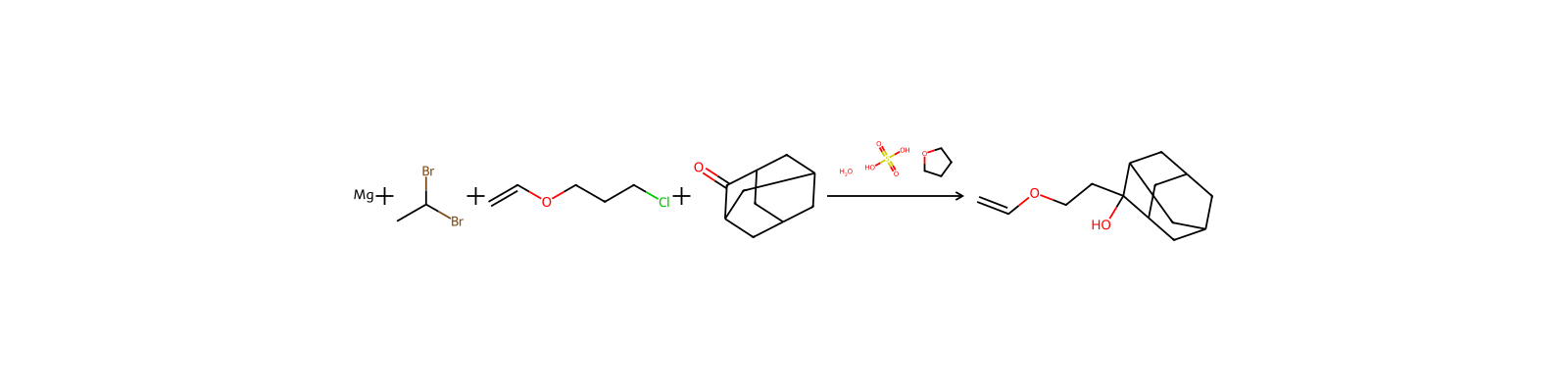
1,1-Dibromoethane → 2-Hydroxy-2-adamantylethyl Vinyl Ether
https://huagongshe.com/de/reaction/22623
Beteiligte Stoffe
| Rolle | Name | HCID | Einwaage |
|---|
| Edukt | 1,1-Dibromoethane | HCID 11201 | — |
| Edukt | Adamantanone | HCID 64151 | — |
| Edukt | Magnesium | HCID 5462224 | — |
| Edukt | 3-Chloropropyl vinyl ether | HCID 22186215 | — |
| Lösungsmittel | Water | HCID 962 | — |
| Lösungsmittel | Sulfuric Acid | HCID 1118 | — |
| Lösungsmittel | Tetrahydrofuran | HCID 8028 | — |
| Produkt | 2-Hydroxy-2-adamantylethyl Vinyl Ether | HCID 86590062 | — |
Reaktionsschritte
(Step-2) Magnesium metal(2.6 g) and anhydrous tetrahydrofuran (hereinafter referred to as THF(100 mL)) were added to a round bottom flask. Next, after dripping a small quantity of dibromoethane into the round bottom flask containing the resulting mixture to promote the reaction, 3-chloropropyl vinyl ether (12 g, 0.1 mol) and anhydrous THF(100 mL) were added drop-wise thereto. Then, the mixture was reacted for 2 hours. After dripping an adequate quantity of THF containing 2-adamantanone (15 g, 0.1 mol) in the mixture, the resulting mixture was refluxed for 12 hours. After the reaction was completed, the reaction mixture was slowly dissolved in excessive water and neutralized with thin H2SO4 solution. Then, the organic layer was extracted from the reaction solution using an adequate quantity of diethyl ether and then dried with anhydrous sodium sulfate. Next, after evaporating the solvent to obtain an oily residue using a rotary evaporator, the product was separated using a column chromatography method (hexane:ethyl acetate=3:1). (Yield: 60%)
Herkunft & Nachweise
| DOI | 10.6084/m9.figshare.5104873.v1 |
|---|
| Patentnummer | US06849378B2 |
|---|
| Quelldatensatz | uspto-grants-2005_02 |
|---|
| ORD ID | ord-8ba09fd2cc7646759768ea7fc99b2cf3 |
|---|
| Quellennotiz | uspto-grants-2005_02 |
|---|