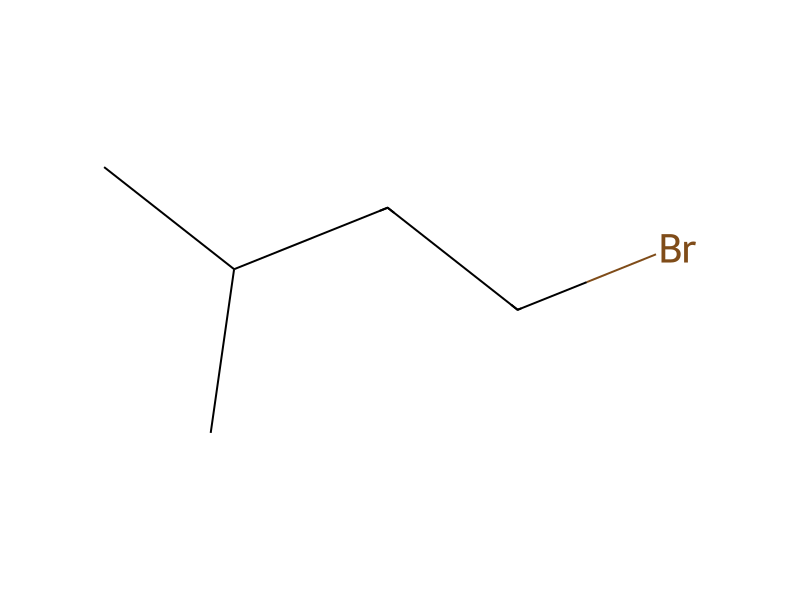
5.15 g (28 mmol) 8 were dissolved in 15 mL DMF (anhydrous, Aldrich) and added to a suspension of 15.5 g (112 mmol, 4 eq.) K2CO3 in 25 mL DMF under nitrogen atmosphere. 13.4 mL (112 mmol, 4 eq.) iso-pentyl bromide were added. The thick, canary-yellow reaction mixture was heated to 90° C. and became stirrable again. It was left at this temperature for at least 8 h. Product formation could be followed by TLC (hexanes/ethyl acetate 9:1, Rf (product)=0.85). After cooling to r.t., DMF was removed with a vacuum rotovap, then ethyl acetate and water were added. After phase separation, the water layer was extracted with ethyl acetate two more times, the organics were pooled, washed with brine, dried with MgSO4, concentrated and put under vacuum overnight. The crude product was purified by column chromatography (hexanes/ethyl acetate 9:1), yielding 5.15 g (80%) of a yellow liquid. 1H NMR (CDCl3) δ 8.42 (dd, J1=1.5 Hz, J2=2.4 Hz, 1H), 7.90 (t, J1=2.4 Hz, J2=2.4 Hz, 1H),7.87 (dd, J1=1.5 Hz, J2=2.4 Hz, 1H), 4.40 (t, J=6.7 Hz, 2H, PhOCH2CH2CH(CH3)2), 4.11 (t, J=6.6 Hz, 2H, PhOCH2CH2CH(CH3)2), 1.93-1.65 (m, 6H), 0.99 (d, J=6.6 Hz, 12H, 2×CH(CH3)2); 13C NMR (CDCl3) 164.38, 159.51, 148.94, 132.69, 121.46, 116.10, 112.87, 67.40, 64.42, 37.38, 37.08, 24.97, 24.77, 22.29; ESI-MS m/z 360 [M+K−2]+, 408 [M+2Na+K], 669 [M2+Na]+.