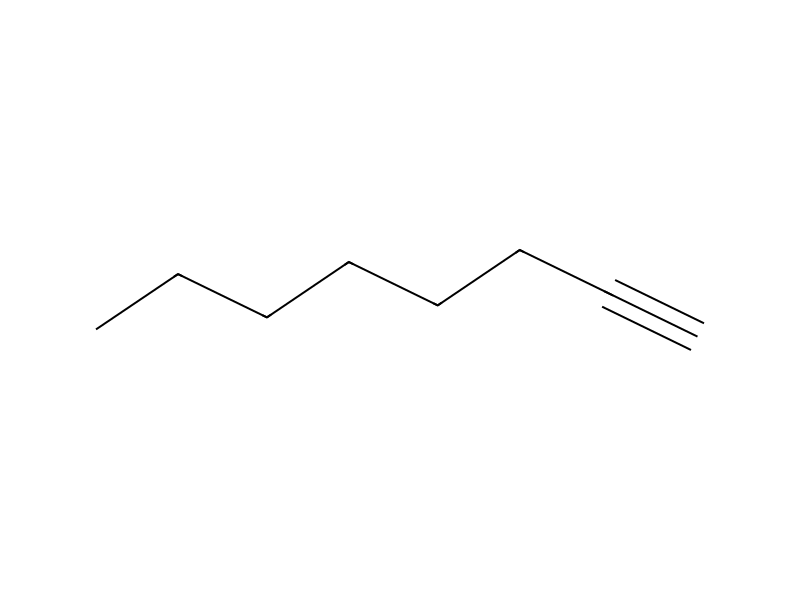
Br[C:2]1[CH:3]=[C:4]([O:9][CH2:10][C@H:11]2[CH2:15][CH2:14][CH2:13][N:12]2[C:16]([O:18][C:19]([CH3:22])([CH3:21])[CH3:20])=[O:17])[CH:5]=[N:6][C:7]=1[Cl:8].[CH:23]#[C:24][CH2:25][CH2:26][CH2:27][CH2:28][CH2:29][CH3:30].C(N(CC)CC)C>C(Cl)Cl.[Cu]I>[C:23]([C:2]1[CH:3]=[C:4]([O:9][CH2:10][C@H:11]2[CH2:15][CH2:14][CH2:13][N:12]2[C:16]([O:18][C:19]([CH3:22])([CH3:21])[CH3:20])=[O:17])[CH:5]=[N:6][C:7]=1[Cl:8])#[C:24][CH2:25][CH2:26][CH2:27][CH2:28][CH2:29][CH3:30]A mixture of 5-bromo-6-chloro-3-(1-BOC-2-(R)-pyrrolidinylmethoxy)pyridine from Example 69a (425 mg, 1.1 mmol), 1-octyne (0.2 mL, 1.4 mmol), Pd(PPh)3Cl2 (20 mg), CuI (catalytic amount) and triethylamine (0.5 mL) in CH2Cl2 (8 mL) was heated at reflux for 16 hours. Heating was continued until no starting material remained. The solvent was removed, and the residue was washed with 10% NaOH then extracted with CH2Cl2. The organic extract was dried over MgSO4 and concentrated. The residue was chromatographed on a silica gel column, eluting with hexane:Et2O 100:6-100:15 to afford to give the title compound (335 mg, 72% yield). MS (CI/NH3) m/z 421 (M+H)+. 1H NMR (CDCl3, 300 MHz) δ 0.90 (m, 3H), 1.32 (m, 4H), 1.48 (s, 9H), 1.49 (m, 2H), 1.62 (m, 2H), 1.88 (m, 2H), 2.00 (m, 2H), 2.48 (m, 2H), 3.34 (m, 2H), 3.90 (m, 1H), 4.12 (m, 2H), 7.30 (br s, 1H), 7.98 (m, 1H).