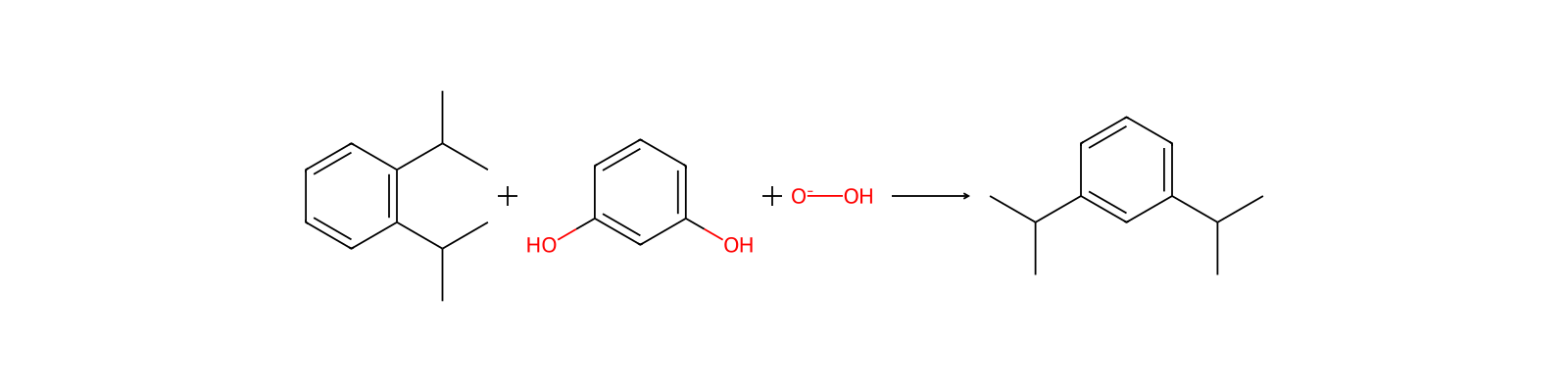
Beteiligte Stoffe
| Rolle | Name | HCID | Einwaage |
|---|
| Edukt | Resorcinol | HCID 5054 | — |
| Edukt | Bis(1-methylethyl)benzene | HCID 11345 | — |
| Edukt | Perhydroxyl radical | HCID 18500 | — |
| Produkt | 1,3-Diisopropylbenzene | HCID 7450 | — |
Reaktionsschritte
By well-known processes, diisopropylbenzene (DIPB) is oxidized to produce, among other products, the dihydroperoxides (DHP) and hydroxyhydroperoxides (HHP) of diisopropylbenzene, for the preparation of resorcinol. Almost all acid-catalyzed decompositions of m-DHP to resorcinol require the use of pure m-DHP. For example, U.S. Pat. No. 3,928,469 disclosed that a crude hydroperoxide mixture which is obtained from the oxidation product of m-diisopropylbenzene, and which has a composition consisting of 72% m-DHP, 20% m-HHP, and 8% others, is cleaved in a usual manner, using a mineral acid catalyst, to give only a low cleavage yield of about 70 to 73% resorcinol based on moles m-DHP used. Yet, there is no practical way to make pure DHP by the hydroperoxidation of m-DIPB and there is no economical way to separate HHP and other products from the hydroperoxidation product to obtain pure DHP.
Herkunft & Nachweise
| DOI | 10.6084/m9.figshare.5104873.v1 |
|---|
| Patentnummer | US04847437 |
|---|
| Quelldatensatz | uspto-grants-1989_07 |
|---|
| ORD ID | ord-ebc24b6bd846407f8d906edfe326c768 |
|---|
| Quellennotiz | uspto-grants-1989_07 |
|---|