Reaktionsgleichung
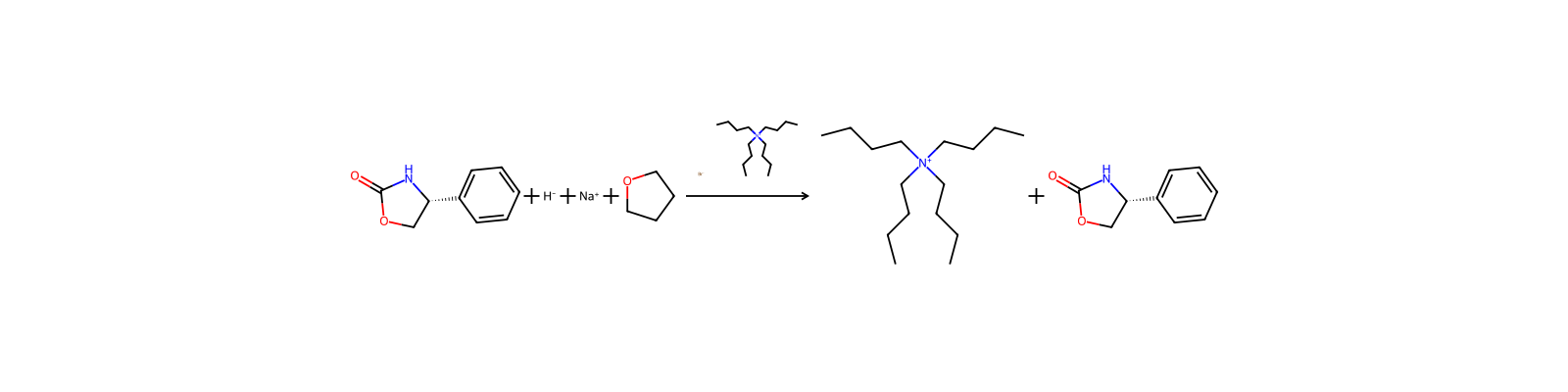
[C:1]1([C@@H:7]2[CH2:11][O:10][C:9](=[O:12])[NH:8]2)[CH:6]=[CH:5][CH:4]=[CH:3][CH:2]=1.[H-].[Na+].[CH2:15]1[CH2:19]O[CH2:17][CH2:16]1>[Br-].C([N+](CCCC)(CCCC)CCCC)CCC>[CH2:17]([N+:8]([CH2:7][CH2:1][CH2:6][CH3:5])([CH2:9][CH2:4][CH2:5][CH3:6])[CH2:7][CH2:1][CH2:2][CH3:3])[CH2:16][CH2:15][CH3:19].[C:1]1([C@@H:7]2[CH2:11][O:10][C:9](=[O:12])[NH:8]2)[CH:2]=[CH:3][CH:4]=[CH:5][CH:6]=1Komponenten
5
Edukt 3



Produkt 1

Reagenzien, Katalysatoren, Lösungsmittel 1

Versuchsvorschrift
To a stirred solution of (R)-4-phenyl-2-oxazolidinone (174 mg, 1.06 mmol) in THF (4 mL) at 0° C., add NaH (4.3 mg, 60% emulsion in oil, 0.106 mmol). Allow the temperature to rise to room temperature over 30 min., then add tetra n-butylammonium bromide (34 mg, 0.106 mmol) to the mixture and stir for another 30 min. to obtain (R)-4-phenyl-2-oxazolidinone tetra n-butylammonium salt.
Quellen und Nachweise
- ORD-Eintrag
- ord-b9cf0611d38749c6a169a2037a147be6
- Quelldatensatz
- uspto-grants-1998_03
- Patentnummer
- US05728827
Verknüpfte Notizen
Wird geladen…