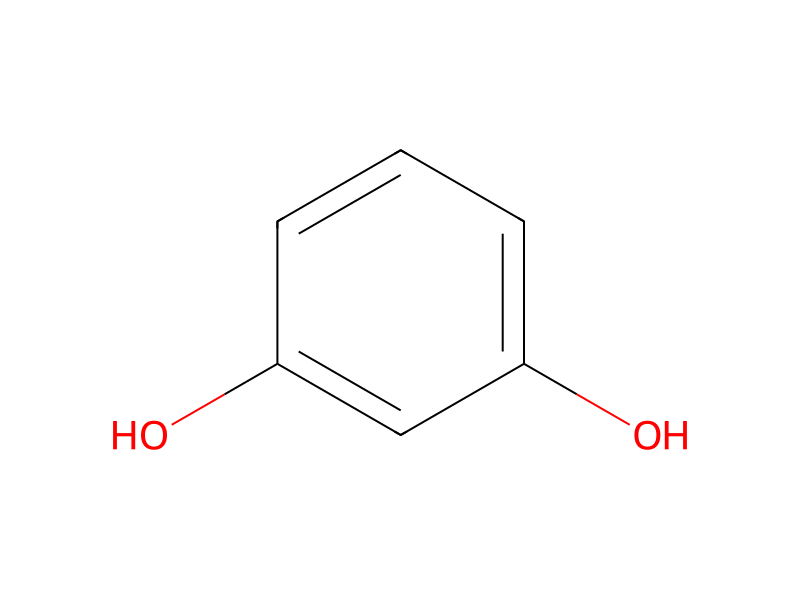
Resorcinol → 3-Hydroxy-8,9,10,11-tetrahydrobenzo[b]cyclohepta[d]pyran-6(7H)-one
Reaktionsgleichung

[C:1]([CH:6]1[CH2:12][CH2:11][CH2:10][CH2:9][CH2:8][C:7]1=O)([O:3][CH2:4][CH3:5])=[O:2].[C:14]1([CH:21]=CC=[C:17](O)[CH:16]=1)[OH:15]>>[OH:15][C:14]1[CH:21]=[C:4]2[C:5]([C:7]3[CH2:8][CH2:9][CH2:10][CH2:11][CH2:12][C:6]=3[C:1](=[O:2])[O:3]2)=[CH:17][CH:16]=1Komponenten


Versuchsvorschrift
The Applicant has now found that this compound can be synthesized in two chemical stages. The first stage consists of condensing in a strong acid (such as sulphuric acid, trifluoroacetic acid or methanesuiphonic acid) 2-carbetoxycycloheptanone with resorcinol, intermediate 3-hydroxy-8,9,10,11-tetrahydrocyclohepta[c]chromen-6(7H)-one is isolated by precipitation using an alcohol/water mixture (for example by adding ethanol then water). In a second stage, sulphonylisocyanate chloride is converted, in toluenic solution, to sulphamoyl chloride, by the action of formic acid, then condensed with the previous intermediate dissolved in a solvent such as DMA. The reaction medium is treated with water and extracted by an organic solvent (preferably 2-methyltetrahydrofurane: MeTHF), and crude compound 1 is then precipitated from the organic phase by adding an antisolvent (preferably methylcyclohexane). Finally pure compound 1 is obtained by recrystallization of the crude product by dissolution in acetone or ethyl acetate while hot and precipitation by adding an antisolvent (preferably methylcyclohexane).
Aufarbeitung
- customcan be synthesized in two chemical stages
Quellen und Nachweise
- ORD-Eintrag
- ord-cd736b62359745698d54852fd07a3081
- Quelldatensatz
- uspto-grants-2014_04
- Patentnummer
- US08691281B2
Notizen zur Reaktion
Wird geladen…