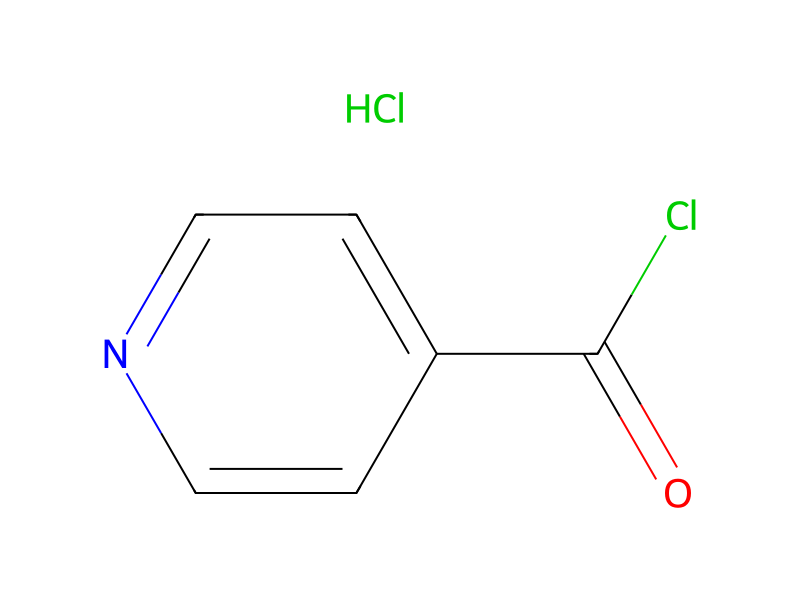
Isonicotinoyl chloride hydrochloride → N-[6-(4-Fluorophenyl)-5-(4-pyridyl)-1H-pyrazolo[3,4-b]pyridin-3-yl]isonicotinamide
HRID 2376787
Reaktionsgleichung

[NH2:1][C:2]1[C:10]2[C:5](=[N:6][C:7]([C:17]3[CH:22]=[CH:21][C:20]([F:23])=[CH:19][CH:18]=3)=[C:8]([C:11]3[CH:16]=[CH:15][N:14]=[CH:13][CH:12]=3)[CH:9]=2)[NH:4][N:3]=1.Cl.[C:25](Cl)(=[O:32])[C:26]1[CH:31]=[CH:30][N:29]=[CH:28][CH:27]=1>N1C=CC=CC=1>[F:23][C:20]1[CH:21]=[CH:22][C:17]([C:7]2[N:6]=[C:5]3[NH:4][N:3]=[C:2]([NH:1][C:25](=[O:32])[C:26]4[CH:31]=[CH:30][N:29]=[CH:28][CH:27]=4)[C:10]3=[CH:9][C:8]=2[C:11]2[CH:16]=[CH:15][N:14]=[CH:13][CH:12]=2)=[CH:18][CH:19]=1Komponenten
4
Edukt 2

Produkt 1

Reagenzien, Katalysatoren, Lösungsmittel 1

Versuchsvorschrift
In a volumetric flask, 3-amino-6-(4-fluorophenyl)-5-(4-pyridyl)-1H-pyrazolo[3,4-b]pyridine (0.20 g, 0.7 mmol, obtained in example 70), isonicotinoyl chloride hydrochloride (0.12 g, 0.7 mmol, obtained in section a) and pyridine (1 mL) were introduced under argon atmosphere. This was stirred at room temperature for 2 days. It was concentrated and the residue dissolved in a mixture of CHCl3 and 1 N HCl. The phases were separated and the aqueous phase was extracted with CHCl3 (×2). The aqueous phase was basified by slow addition of 1 N NaOH. Brine was added and extracted with CHCl3 and EtOAc. The organic phase was dried over Na2SO4 and concentrated to dryness. The crude product obtained was purified by chromatography on silica gel using CHCl3-MeOH mixtures of increasing polarity as eluent, to afford 98 mg of the title compound (yield: 68%).