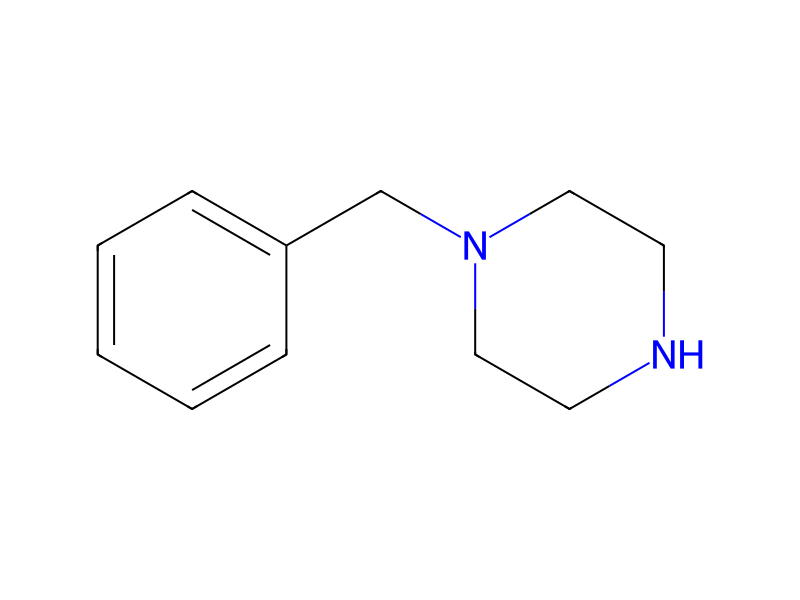
O[N:2]1C2C=CC=CC=2N=N1.C(N(CC)CC)C.[NH:18]1[C:26]2[C:21](=[CH:22][CH:23]=[CH:24][CH:25]=2)[CH:20]=[C:19]1[CH2:27][C:28]([OH:30])=O.[CH2:31]([N:38]1[CH2:43][CH2:42][NH:41][CH2:40][CH2:39]1)[C:32]1[CH:37]=[CH:36][CH:35]=[CH:34][CH:33]=1.Cl.CN(C)CCCN=C=NCC>C1COCC1>[CH2:31]([N:38]1[CH2:43][CH2:42][N:41]([NH:2][C:28](=[O:30])[CH2:27][C:19]2[NH:18][C:26]3[C:21]([CH:20]=2)=[CH:22][CH:23]=[CH:24][CH:25]=3)[CH2:40][CH2:39]1)[C:32]1[CH:33]=[CH:34][CH:35]=[CH:36][CH:37]=11-Hydroxybenzotriazole (324 mg, 2.4 mmol) and triethylamine (446 μl, 3.2 mmol) were added to a solution of indole-2-acetic acid (350 mg, 2 mmol) and 1-benzylpiperazine (352 mg, 2 mmol) in THF (25 ml), followed after 5 min by 1-(3-dimethylaminopropyl)-3-ethyl carbodiimide hydrochloride (576 mg, 3 mmol) and the mixture stirred for 15 h. The mixture was concentrated in vacuo and the residue partitioned between citric acid (1M, 30 ml) and ethyl acetate (25 ml), the phases were separated and the aqueous layer extracted with ethyl acetate (2×25 ml). The combined organic layers were washed with sodium bicarbonate (satd., 2×10 ml) and brine (satd., 20 ml), dried (Na2SO4) and evaporated in vacuo to give 1-benzyl-4-(2-indolylacetamido)piperazine as a pink solid (200 mg, 30%), m/z (CI+, NH3) 334 (M+1)+.