Dimethylcarbamoyl Chloride → N'-(4-{[(3,6-Dichloropyridin-2-yl)methyl]sulfanyl}phenyl)-N,N-dimethylurea
HRID 2399078
Reaktionsgleichung

[Cl:1][C:2]1[C:3]([CH2:9][S:10][C:11]2[CH:16]=[CH:15][C:14]([NH2:17])=[CH:13][CH:12]=2)=[N:4][C:5]([Cl:8])=[CH:6][CH:7]=1.[CH3:18][N:19]([CH3:23])[C:20](Cl)=[O:21]>N1C=CC=CC=1>[Cl:1][C:2]1[C:3]([CH2:9][S:10][C:11]2[CH:16]=[CH:15][C:14]([NH:17][C:20](=[O:21])[N:19]([CH3:23])[CH3:18])=[CH:13][CH:12]=2)=[N:4][C:5]([Cl:8])=[CH:6][CH:7]=1Komponenten
4
Edukt 2
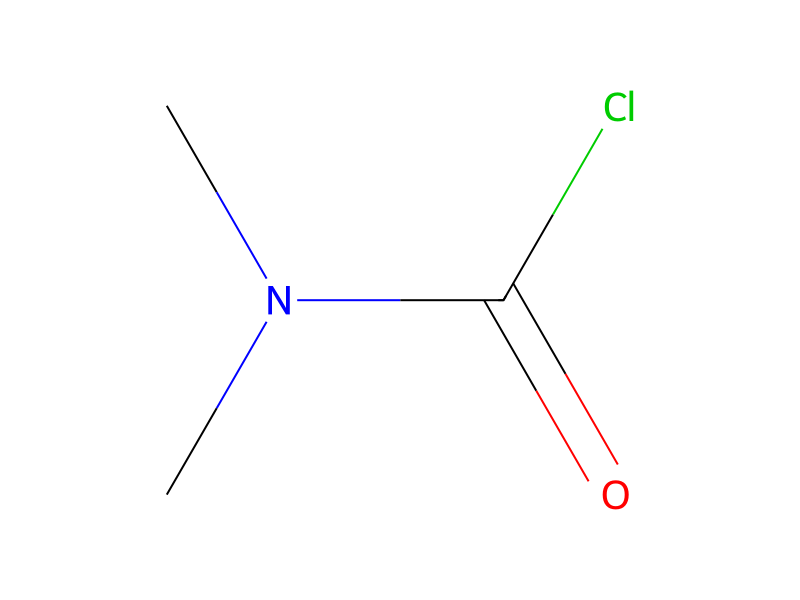

Produkt 1

Reagenzien, Katalysatoren, Lösungsmittel 1

Versuchsvorschrift
A solution of 4-(((3,6-dichloro-2-pyridinyl)methyl)-thio)benzenamine (10 grams; 0.035 mole) in 25 ml. of dry pyridine was prepared and dimethyl carbamoyl chloride (3.77 grams; 0.035 mole) added thereto while maintaining the temperature of the reaction mixture at 24°-45° C. The resulting reaction mixture was stirred at ambient temperatures for a period of about 15 hours and then mixed with ice and allowed to stand for a period of about 2 hours. The aqueous layer was decanted and the residue washed with water and recrystallized twice from ether. As a result of the above operations, the desired N'-(4-(((3,6-dichloro-2-pyridinyl)-methyl)thio)phenyl)-N,N-dimethyl urea compound was recovered as a crystalline solid having a melting point of 112°-113.5° C.