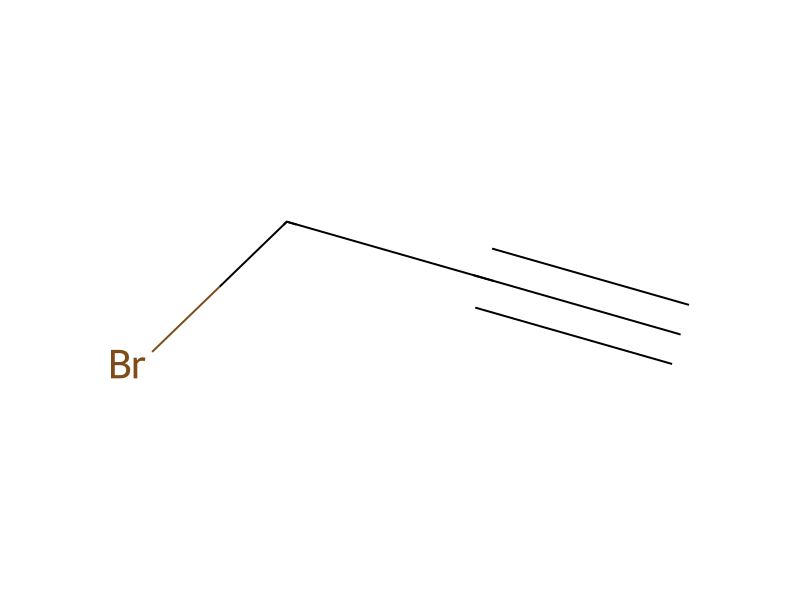
[OH:1][C:2]1[CH:7]=[CH:6][C:5]([O:8][CH3:9])=[C:4]([O:10][CH3:11])[CH:3]=1.C(=O)([O-])[O-].[K+].[K+].[CH3:18][C:19]([CH3:21])=O.C(Br)C#C>C1(C)C=CC=CC=1>[CH2:21]([O:1][C:2]1[CH:7]=[CH:6][C:5]([O:8][CH3:9])=[C:4]([O:10][CH3:11])[CH:3]=1)[C:19]#[CH:18]Following the same procedure as in Example 1, 13.8 g (0.1 mole) of 1-hydroxy-3,4-dimethoxybenzene, 13.8 g (0.1 mole) of anhydrous potassium carbonate in ml 50 of acetone and 14.9 g (0.1 mole) of a solution of propargyl bromide in toluene (80% w/w) were reacted. After work up and evaporation of the mixture u.v. (25° C./21 mbar) a residue was obtained that was purified on silica gel column (eluant n-hexane:ethyl acetate 5:1 v/v). A thick oil that after some time solidified with low melting point (28-30° C.) (b.p.: 109-110° C./ 3 mbar) was obtained whose NMR and MS analyses corresponded to those of the aforementioned compound.