Formaldehyde → HCID 20311821, Verbindung
Reaktionsgleichung
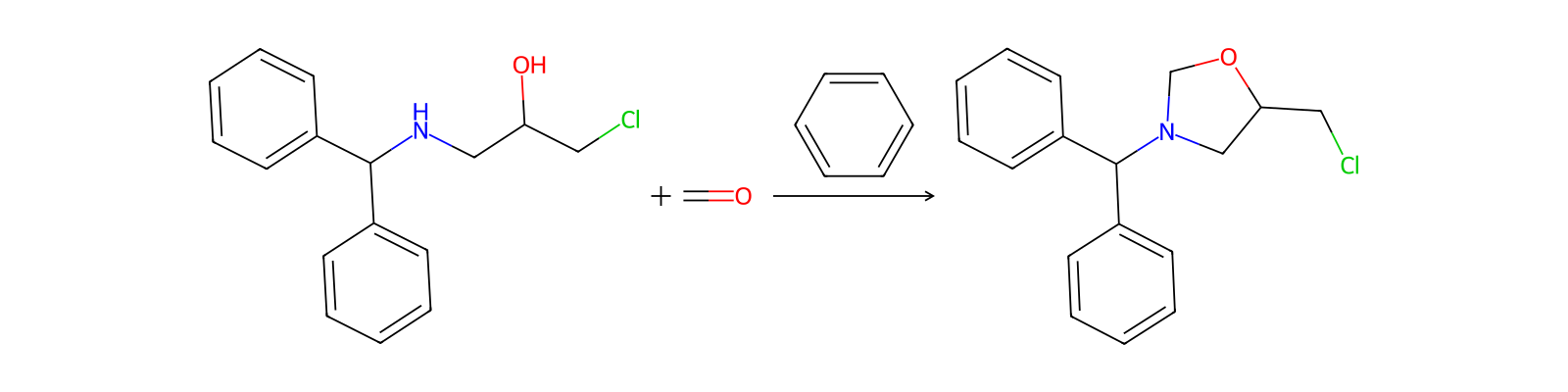
[C:1]1([CH:7]([NH:14][CH2:15][CH:16]([OH:19])[CH2:17][Cl:18])[C:8]2[CH:13]=[CH:12][CH:11]=[CH:10][CH:9]=2)[CH:6]=[CH:5][CH:4]=[CH:3][CH:2]=1.[CH2:20]=O>C1C=CC=CC=1>[C:1]1([CH:7]([C:8]2[CH:9]=[CH:10][CH:11]=[CH:12][CH:13]=2)[N:14]2[CH2:15][CH:16]([CH2:17][Cl:18])[O:19][CH2:20]2)[CH:2]=[CH:3][CH:4]=[CH:5][CH:6]=1Komponenten
4
Edukt 2


Produkt 1

Reagenzien, Katalysatoren, Lösungsmittel 1

Versuchsvorschrift
A mixture of 27.6 g of 1-diphenylmethylamino-2-hydroxy-3-chloropropane, 10 ml of a 37% strength solution of formaldehyde and 200 ml of benzene is heated to the reflux temperature, while continuously separating off water. The mixture is then evaporated in vacuo and 3-diphenylmethyl-5-chloromethyloxazolidine is obtained as a yellowish oil which, without purification, is heated together with the reacton solution obtained according to Example 43 from 2.3 g of sodium, 100 ml of ethanol and 17.8 g of 4-trans-propenylguaethol, to 100° in an autoclave for 12 hours. After cooling, the sodium chloride which has precipitated is filtered off. 50 ml of 4 N hydrochloric acid are added to the resulting alcoholic solution of 3-diphenylmethyl-5-(2-ethoxy-5-trans-propenyl-phenoxymethyl)-oxazolidine and the mixture is left to stand for 4 hours at room temperature.