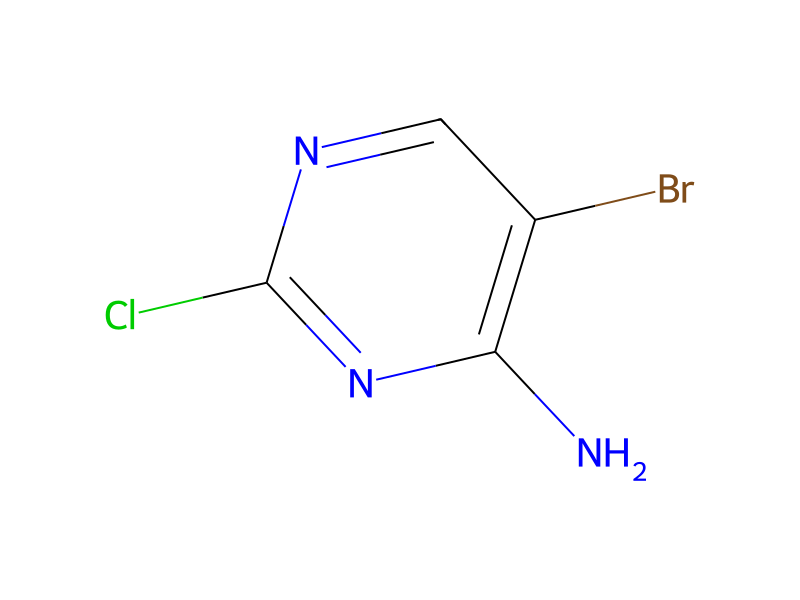
Br[C:2]1[C:3]([NH2:9])=[N:4][C:5]([Cl:8])=[N:6][CH:7]=1.C1(C)C=CC=CC=1.C([Sn](CCCC)(CCCC)[CH:22]=[CH:23][O:24][CH2:25][CH3:26])CCC>C(OCC)(=O)C.C1C=CC([P]([Pd]([P](C2C=CC=CC=2)(C2C=CC=CC=2)C2C=CC=CC=2)([P](C2C=CC=CC=2)(C2C=CC=CC=2)C2C=CC=CC=2)[P](C2C=CC=CC=2)(C2C=CC=CC=2)C2C=CC=CC=2)(C2C=CC=CC=2)C2C=CC=CC=2)=CC=1>[Cl:8][C:5]1[N:4]=[C:3]([NH2:9])[C:2]([CH:22]=[CH:23][O:24][CH2:25][CH3:26])=[CH:7][N:6]=1A 500 mL round bottomed flask is charged with 5-bromo-2-chloropyrimidin-4-ylamine (1) (10 g, 48 mmol), tetrakis(triphenylphosphine)palladium(0) (2.8g, 2.5 mmol), and toluene (200 mL). Tributyl-(2-ethoxyvinyl)-stannane (22 g, 60 mmol) is added and the reaction heated to 110° C. with stirring for approximately 15 hours. After cooling to room temperature, the solution is diluted with 100 mL ethyl acetate and washed with water and brine. The organic extract is dried over Na2SO4, filtered, and concentrated under reduced pressure. Purification by column chromatography (SiO2, Hexane:Ethyl acetate/5:1) provides 2 (4.4 g, 46%) as a yellow solid.