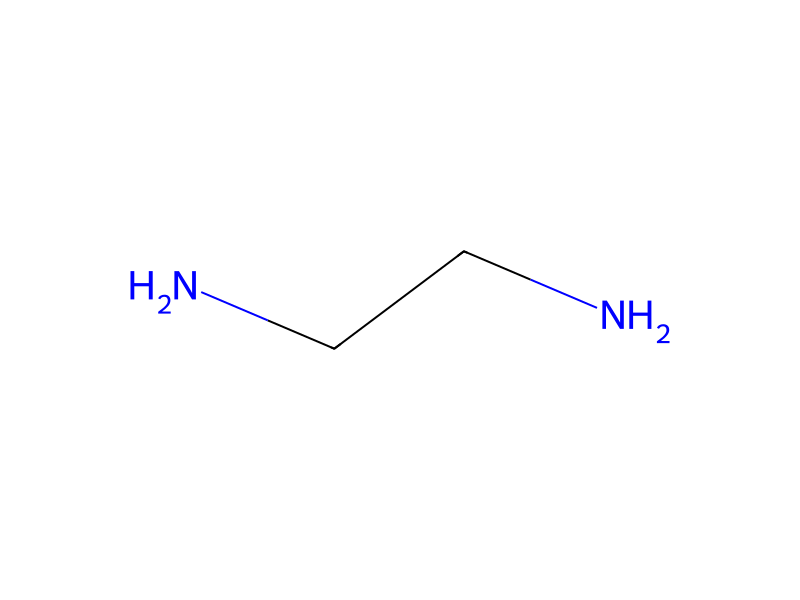
[O:1]1[CH:5]=[CH:4][N:3]=[C:2]1[C@H:6]([NH:8][C:9]([C:11]1[C:19]2[C:14](=[N:15][CH:16]=[C:17]([C:20]3[N:21]=[CH:22][N:23]4[CH:28]=[C:27]([F:29])[CH:26]=[CH:25][C:24]=34)[N:18]=2)[N:13](COCC[Si](C)(C)C)[CH:12]=1)=[O:10])[CH3:7].FC(F)(F)C(O)=O.C(N)CN>ClCCl>[O:1]1[CH:5]=[CH:4][N:3]=[C:2]1[C@H:6]([NH:8][C:9]([C:11]1[C:19]2[C:14](=[N:15][CH:16]=[C:17]([C:20]3[N:21]=[CH:22][N:23]4[CH:28]=[C:27]([F:29])[CH:26]=[CH:25][C:24]=34)[N:18]=2)[NH:13][CH:12]=1)=[O:10])[CH3:7]In a round-bottomed flask, 2-(6-fluoro-imidazo[1,5-a]pyridin-1-yl)-5-(2-trimethylsilanylethoxymethyl)-5H-pyrrolo[2,3-b]pyrazine-7-carboxylic acid ((R)-1-oxazol-2-yl-ethyl)-amide (107 mg, 0.205 mmol) was dissolved in dichloromethane (1.1 ml) and trifluoroacetic acid (0.64 ml, 8.3 mmol) was added. The reaction mixture was stirred at room temperature for 2 h then concentrated. The residue was dissolved in dichloromethane (1.1 ml) and ethylenediamine (0.84 ml, 12.4 mmol) was added. The yellow reaction mixture was stirred at room temperature for 1 h then quenched with water and diluted with ethyl acetate. The resultant suspension was filtered, washed with hot water and ethyl acetate and dried under high vacuum to provide 76 mg (90%) of 2-(6-fluoro-imidazo[1,5-a]pyridin-1-yl)-5H-pyrrolo[2,3-b]pyrazine-7-carboxylic acid ((R)-1-oxazol-2-yl-ethyl)-amide as a yellow powder. MS: (M+Na)+=414; 1H NMR (DMSO-d6, 300 MHz): δ (ppm) 12.76 (br. s., 1H), 9.12 (s, 1H), 8.70 (dd, J=4.7, 2.1 Hz, 1H), 8.60 (d, J=8.7 Hz, 1H), 8.54 (s, 1H), 8.36-8.46 (m, 2H), 8.11 (s, 1H), 7.25 (s, 1H), 7.04 (ddd, J=9.9, 7.8, 1.9 Hz, 1H), 5.45-5.60 (m, 1H), 1.65 (d, J=6.8 Hz, 3H).
Wird geladen…