StartseiteMCPWorkbenchSkills
StartseiteWorkbenchBenachrichtigungenMein Bereich
llms.txt · MCP-AnleitungDatenschutz · Nutzungsbedingungen · Supportv1.8.0
  1. Startseite
  2. /Reaktion

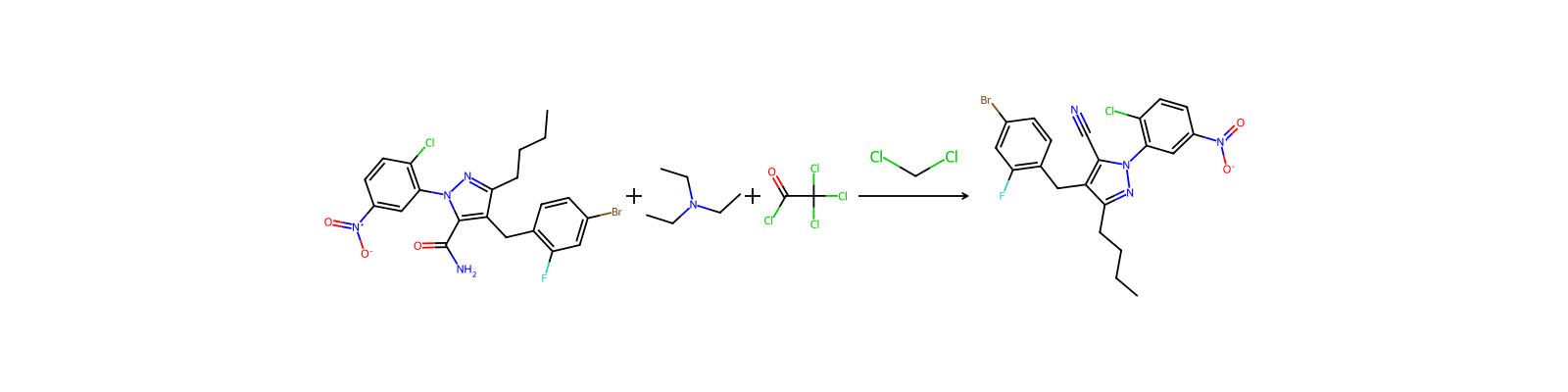
Trichloroacetyl chloride → 4-(4-Bromo-2-fluorobenzyl)-3-n-butyl-1-(2-chloro-5-nitrophenyl)-1H-pyrazole-5-carbonitrile

HRID 257565
Notizen
Druckvorschau

Reaktionsgleichung

Reaktionsgleichung von HRID 257565
[Br:1][C:2]1[CH:30]=[CH:29][C:5]([CH2:6][C:7]2[C:8]([CH2:25][CH2:26][CH2:27][CH3:28])=[N:9][N:10]([C:15]3[CH:20]=[C:19]([N+:21]([O-:23])=[O:22])[CH:18]=[CH:17][C:16]=3[Cl:24])[C:11]=2[C:12]([NH2:14])=O)=[C:4]([F:31])[CH:3]=1.C(N(CC)CC)C.ClC(Cl)(Cl)C(Cl)=O>C(Cl)Cl>[Br:1][C:2]1[CH:30]=[CH:29][C:5]([CH2:6][C:7]2[C:8]([CH2:25][CH2:26][CH2:27][CH3:28])=[N:9][N:10]([C:15]3[CH:20]=[C:19]([N+:21]([O-:23])=[O:22])[CH:18]=[CH:17][C:16]=3[Cl:24])[C:11]=2[C:12]#[N:14])=[C:4]([F:31])[CH:3]=1
KomponentenReaktionsbedingungenVersuchsvorschriftAufarbeitungQuellen und NachweiseNotizen zur Reaktion

Komponenten

5

Edukt 3

HCID 6420Trichloroacetyl chlorideHCID 8471TriethylamineHCID 542034724-(4-Bromo-2-fluorobenzyl)-3-n-butyl-1-(2-chloro-5-nitrophenyl)-1H-pyrazole-5-carboxamide

Produkt 1

HCID 197832514-(4-Bromo-2-fluorobenzyl)-3-n-butyl-1-(2-chloro-5-nitrophenyl)-1H-pyrazole-5-carbonitrileAusbeute 69 %

Reagenzien, Katalysatoren, Lösungsmittel 1

HCID 6344
Dichloromethane
Lösungsmittel

Reaktionsbedingungen

Temperatur
0 °C

Versuchsvorschrift

A mixture of 600 mg (1.18 mmol) of 4-(4-bromo-2-fluorobenzyl)-3-n-butyl-1-(2-chloro-5-nitrophenyl)-1H-pyrazole-5-carboxamide (from Step E), 330 μL (238 mg, 2.35 mmol) of triethylamine, and 7 mL of methylene chloride was cooled to 0° C. and treated with 145 μL of trichloroacetyl chloride. The mixture was stirred under N2 and allowed to warm to room temperature. After 3 hours, the mixture was concentrated to dryness. The orange residue was triturated with ether. The insoluble material was removed by filtration. The filtrate was washed with 0.2N HCl followed by 0.25N NaOH. The organic layer, after being dried over Na2SO4, was filtered and concentrated. The orange residual oil was flash chromatographed on silica gel (elution with 4:1 and then 3:1 hexane-EtOAc) to give 399 mg (69%) of the title compound as a yellow oil; nearly homogeneous by TLC in 3:1 hexane-EtOAc; mass spectrum (FAB) m/e 491, 493 (M+1)+. 200 MHz 1H NMR (CDCl3) δ0.91 (t, J=7.1 Hz, 3H), 1.36 (m, 2H), 1.61 (m, 2H, partially obscured by H2O peak), 2.61 (t, J=7.7 Hz, 2H), 3.97 (s, 2H), 7.07 (dd, J=8, 8 Hz, 1H), 7.26-7.31 (m, 2H), 7.78 (d, J=8.8 Hz, 1H), 8.31-8.39 (m, 2H).

Aufarbeitung

  1. temperatureto warm to room temperature
  2. concentrationthe mixture was concentrated to dryness
  3. customThe orange residue was triturated with ether
  4. customThe insoluble material was removed by filtration
  5. washThe filtrate was washed with 0.2N HCl
  6. dry with materialThe organic layer, after being dried over Na2SO4
  7. filtrationwas filtered
  8. concentrationconcentrated
  9. customchromatographed on silica gel (
  10. washelution with 4:1

Quellen und Nachweise

ORD-Eintrag
ord-ce6d4c531ac343d580b5f5ffb99e385a
Quelldatensatz
uspto-grants-1993_11
DOI
10.6084/m9.figshare.5104873.v1
Patentnummer
US05262412

Notizen zur Reaktion

Wird geladen…

Auf dieser SeiteKomponentenReaktionsbedingungenVersuchsvorschriftAufarbeitungQuellen und NachweiseNotizen zur Reaktion