Hydrogen Bromide → 3,4-Dihydroxy-5-nitrobenzaldehyde
HRID 274431
Reaktionsgleichung

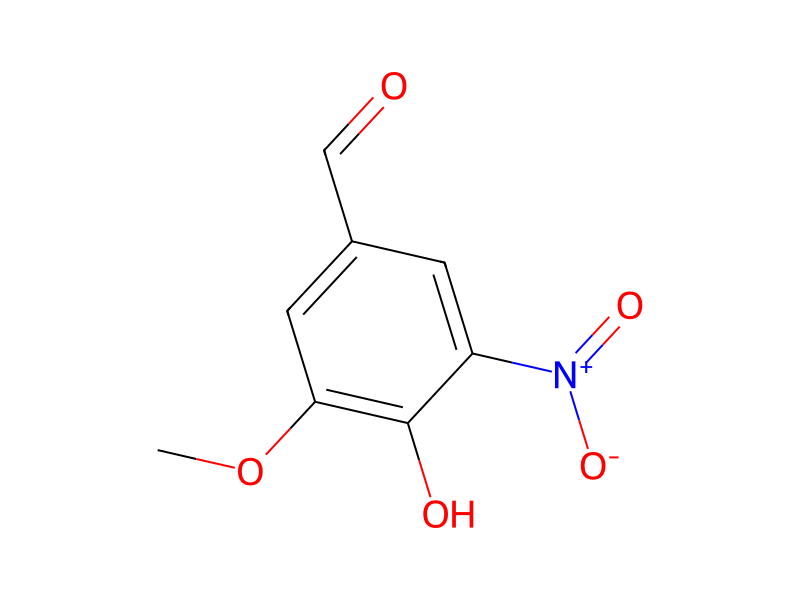
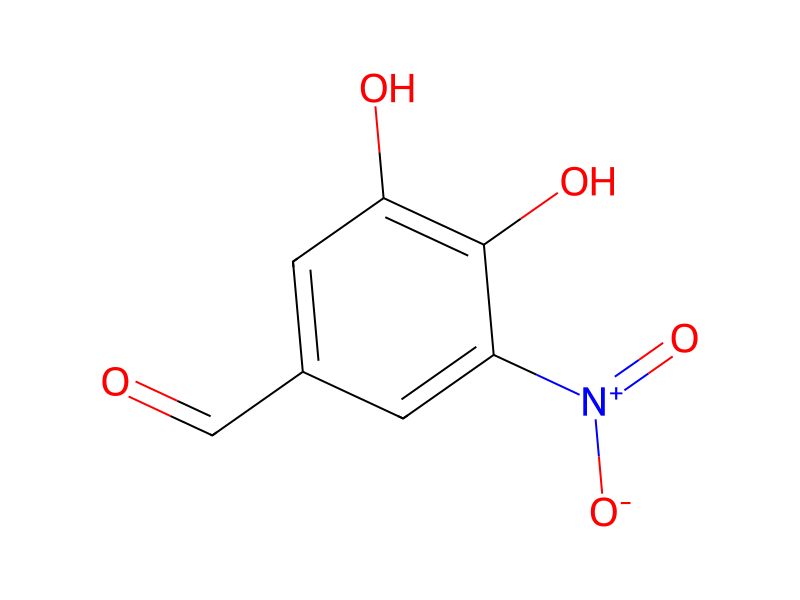
[OH:1][C:2]1[C:9]([N+:10]([O-:12])=[O:11])=[CH:8][C:5]([CH:6]=[O:7])=[CH:4][C:3]=1[O:13]C.Br>C(Cl)Cl>[OH:13][C:3]1[CH:4]=[C:5]([CH:8]=[C:9]([N+:10]([O-:12])=[O:11])[C:2]=1[OH:1])[CH:6]=[O:7]Komponenten
4
Edukt 2

Produkt 1
Reagenzien, Katalysatoren, Lösungsmittel 1

Versuchsvorschrift
17.1 g of 4-hydroxy-3-methoxy-5-nitrobenzaldehyde are treated with 170 ml of constant-boiling hydrobromic acid and heated under reflux for 3.5 hours. After cooling the separated precipitate is filtered under suction, washed twice with ice-water and taken up in ethyl acetate. The organic phase is washed twice with 50 ml of sodium chloride solution each time, dried over magnesium sulfate and evaporated in a water-jet vacuum. The crystals obtained are taken up in methylene chloride, whereupon the solution is filtered over a ten-fold amount of silica gel. The material obtained is crystallized from ethyl acetate/isopropyl ether. There is obtained 3,4-dihydroxy-5-nitrobenzaldehyde in the form of yellow crystals of m.p. 142°-143°.