HuagongsheHuagongshe Chemie-Druckbericht · Nur für Forschungszwecke
HRID 31074Erstellt: 23. Oktober 2026
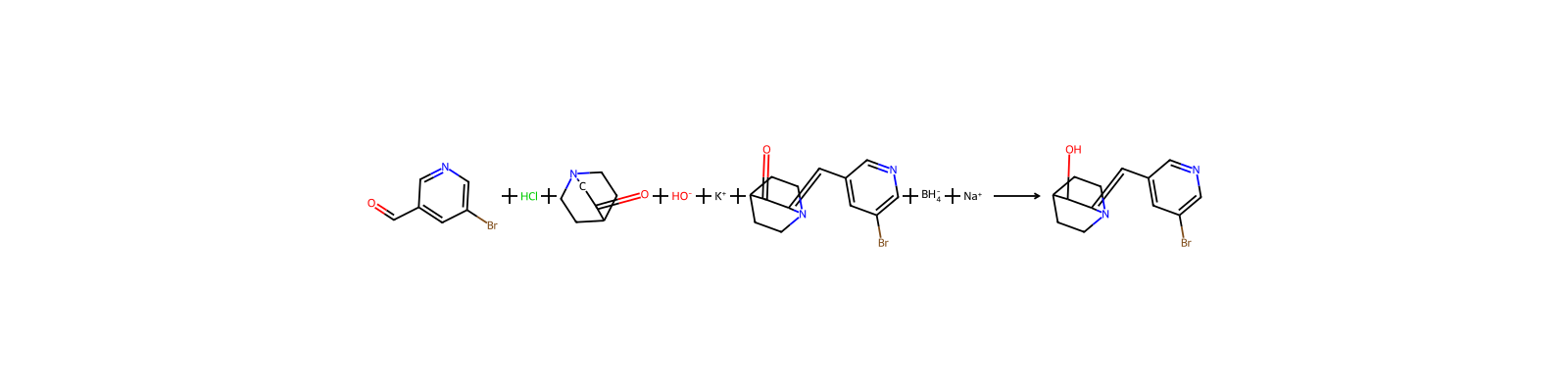
Potassium Hydroxide → 2-((5-Bromo-3-pyridinyl)methylene)-1-azabicyclo[2.2.2]octan-3-ol
https://huagongshe.com/de/reaction/31074
Beteiligte Stoffe
| Rolle | Name | HCID | Einwaage |
|---|
| Edukt | Potassium Hydroxide | HCID 14797 | — |
| Edukt | 1-Azabicyclo(2.2.2)octan-3-one, hydrochloride (1:1) | HCID 102019 | — |
| Edukt | 5-Bromo-3-pyridinecarboxaldehyde | HCID 2784734 | — |
| Edukt | Sodium borohydride | HCID 4311764 | — |
| Edukt | 2-((5-Bromo-3-pyridinyl)methylene)-1-azabicyclo[2.2.2]octan-3-one | HCID 54525186 | — |
| Produkt | 2-((5-Bromo-3-pyridinyl)methylene)-1-azabicyclo[2.2.2]octan-3-ol | HCID 66773101 | — |
Reaktionsschritte
The manner in which 2-((4-, 5-, and 6-substituted-3-pyridinyl)methyl)-1-azabicyclo[2.2.2]octanes can be synthesized can vary. For example, 5-bromopyridine-3-carboxaldehyde and 3-quinuclidinone hydrochloride (commercially available from Aldrich) can be reacted together in the presence of methanolic potassium hydroxide as described in Neilsen and Houlihan, Org. React. 16: 1 (1968). The aldol condensation product, 2-((5-bromo-3-pyridinyl)methylene)-1-azabicyclo[2.2.2]octan-3-one, can then be treated with sodium borohydride to yield the alcohol, 2-((5-bromo-3-pyridinyl)methylene)-1-azabicyclo[2.2.2]octan-3-ol, as a crystalline solid. This intermediate is reacted with neat thionyl chloride at room temperature to give 3-chloro-2-((5-bromo-3-pyridinyl)methylene)-1-azabicyclo[2.2.2]octane dihydrochloride as a pure crystalline solid. Reductive removal of the chlorine can be accomplished using lithium trimethoxyaluminum hydride and copper iodide as described by Masamune et al., J. Am. Chem. Soc. 95: 6452 (1973) to give the desired product, 2-((5-bromo-3-pyridinyl)methylene)-1-azabicyclo[2.2.2]octane, as a crystalline solid. This methylene intermediate can then be converted to the desired product, 2-((5-bromo-3-pyridinyl)methyl)-1-azabicyclo[2.2.2]octane, by hydrogenation in the presence of palladium catalyst. The isomeric compounds, 2-((4-bromo-3-pyridinyl)methyl)-1-azabicyclo[2.2.2]octane and 2-((6-bromo-3-pyridinyl)methyl)-1-azabicyclo[2.2.2]octane can be prepared in a similar manner by replacing 5-bromopyridine-3-carboxaldehyde with 4-bromopyridine-3-carboxaldehyde or 6-bromopyridine-3-carboxaldehyde, respectively, in the synthetic approach given above.
Herkunft & Nachweise
| DOI | 10.6084/m9.figshare.5104873.v1 |
|---|
| Patentnummer | US07425561B2 |
|---|
| Quelldatensatz | uspto-grants-2008_09 |
|---|
| ORD ID | ord-494f6c2dda4746b9942c7e726b8cfaa2 |
|---|
| Quellennotiz | uspto-grants-2008_09 |
|---|