Reaktionsgleichung

[Br:1][C:2]1[CH:11]=[C:10]([N+]([O-])=O)[C:9]2[C:4](=[CH:5][CH:6]=[CH:7][CH:8]=2)[N:3]=1.[OH:15][C:16]1[CH:29]=[CH:28][C:19]([O:20][CH:21]([CH3:27])[C:22]([O:24][CH2:25][CH3:26])=[O:23])=[CH:18][CH:17]=1.N1C2C(=CC=CC=2)C=CC=1>>[Br:1][C:2]1[CH:11]=[C:10]([O:15][C:16]2[CH:17]=[CH:18][C:19]([O:20][CH:21]([CH3:27])[C:22]([O:24][CH2:25][CH3:26])=[O:23])=[CH:28][CH:29]=2)[C:9]2[C:4](=[CH:5][CH:6]=[CH:7][CH:8]=2)[N:3]=1Komponenten
4
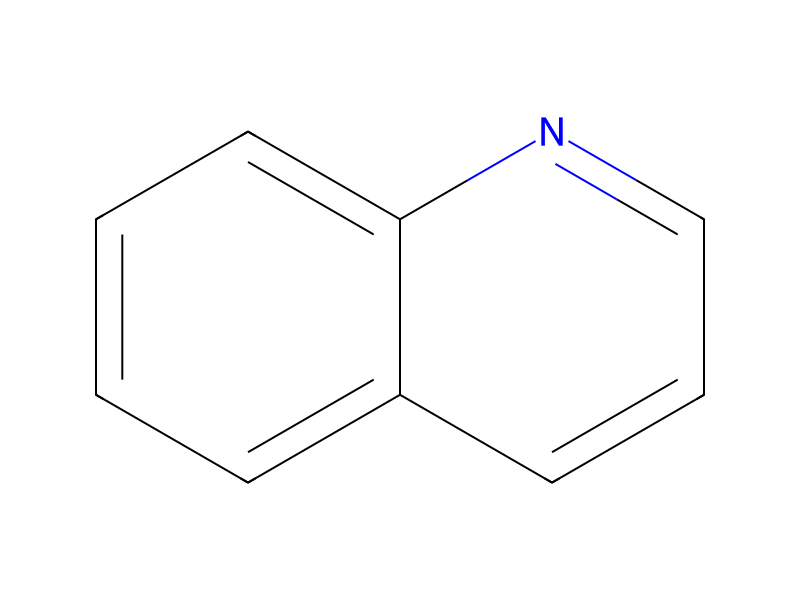


Versuchsvorschrift
Ethyl 2-[4-(2-bromoquinolin-4-yloxy)phenoxy]propionate (40) was prepared from 2-bromo-4-nitroquinoline (Chem Abstracts 51: 6639) and ethyl 2-(4-hydroxyphenoxy)-propionate following essentially the same procedure as that described in Example 1. The compound was isolated as a colourless oil which solidified slowly on standing. Proton magnetic resonance spectrum (CDCl3 ; δ in ppm): 8.5-7.4 (4H, m, quinoline protons); 7.1 (4H, d of d, phenyl protons); 6.6 (1H, s, C3 quinoline proton); 4.8 (1H, q, CHCH3); 4.3 (2H, q, OCH2CH3); 1.65 (3H, d, CHCH3); 1.3 (3H t, OCH2CH3).
Aufarbeitung
- customThe compound was isolated as a colourless oil which
Quellen und Nachweise
- ORD-Eintrag
- ord-f2a6132572cd470096f96f4457c7b91f
- Quelldatensatz
- uspto-grants-1984_04
- Patentnummer
- US04444584
Verknüpfte Notizen
Wird geladen…