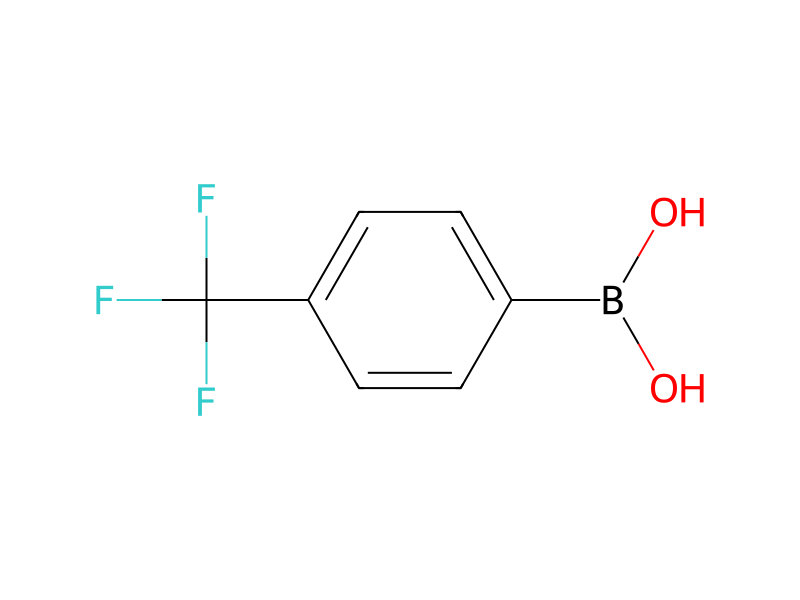
Br[C:2]1[CH:3]=[CH:4][C:5]([CH:8]=[O:9])=[N:6][CH:7]=1.C(=O)([O-])[O-].[Na+].[Na+].[F:16][C:17]([F:28])([F:27])[C:18]1[CH:23]=[CH:22][C:21](B(O)O)=[CH:20][CH:19]=1>COCCOC.C1C=CC([P]([Pd]([P](C2C=CC=CC=2)(C2C=CC=CC=2)C2C=CC=CC=2)([P](C2C=CC=CC=2)(C2C=CC=CC=2)C2C=CC=CC=2)[P](C2C=CC=CC=2)(C2C=CC=CC=2)C2C=CC=CC=2)(C2C=CC=CC=2)C2C=CC=CC=2)=CC=1>[F:16][C:17]([F:28])([F:27])[C:18]1[CH:23]=[CH:22][C:21]([C:2]2[CH:3]=[CH:4][C:5]([CH:8]=[O:9])=[N:6][CH:7]=2)=[CH:20][CH:19]=1439 mg (0.38 mmol) Pd(PPh3)4 was added under argon at room temperature (r.t.) to a solution of 823 mg (3.76 mmol) 5-bromo-pyridine-2-carbaldehyde in 30 ml 1,2-dimethoxyethane and stirred for 15 min. 14.5 ml (29.0 mmol) of 2 M sodium carbonate solution and 1.00 g (5.27 mmol) 4-trifluoromethyl-phenylboronic acid were added and the mixture heated to boiling temperature for 18 hours (h). The reaction mixture was cooled to room temperature (r.t.), filtered, and the filtrate evaporated. The residue was taken up with ethyl acetate, washed twice with water, dried over sodium sulphate and evaporated. Chromatography on silica (eluent: ethyl acetate/n-heptane 1:3) gave 630 mg (48%) of 5-(4-trifluoromethyl-phenyl)-pyridine-2-carbaldehyde.