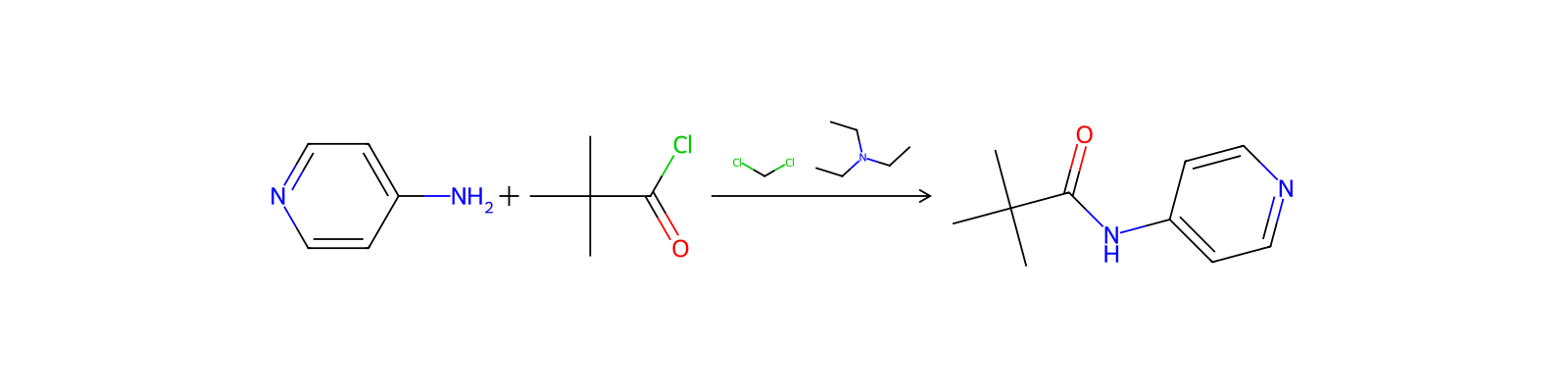
Beteiligte Stoffe
| Rolle | Name | HCID | Einwaage |
|---|
| Edukt | 4-Aminopyridine | HCID 1727 | — |
| Edukt | Pivaloyl chloride | HCID 62493 | — |
| Lösungsmittel | Dichloromethane | HCID 6344 | — |
| Lösungsmittel | Triethylamine | HCID 8471 | — |
| Produkt | 4-(2,2,2-Trimethylacetamido)pyridine | HCID 427059 | — |
Reaktionsschritte
To a solution of 20.0 g of 4-aminopyridine in 100 mL of dichloromethane, 32.6 mL of triethylamine was added at 0° C., followed by 27.5 mL of pivaloyl chloride, and stirred at this temperature for 1 hour. The organic layer was washed successively with water and saturated brine, dried over anhydrous magnesium sulfate, and the solvent was evaporated, and the precipitated crystals were collected by filtration, and washed with a mixed solvent of diethyl ether and n-hexane. The filtrate was diluted with ethanol, and treated with 5 N sodium hydroxide at room temperature, thereby hydrolyzing coexisting dipivaloyl compounds into monopivaloyl compounds. Following neutralization with 5N hydrochloric acid, and extraction with ethyl acetate, the organic layer was washed with saturated brine, dried over anhydrous magnesium sulfate, and the solvent was evaporated, the precipitated crystals were collected by filtration, and washed with a mixed solvent of diethyl ether and n-hexane. This was then combined with the previously obtained crystals, to afford 25.1 g of the title compound as colorless crystals.
Herkunft & Nachweise
| DOI | 10.6084/m9.figshare.5104873.v1 |
|---|
| Patentnummer | US07429609B2 |
|---|
| Quelldatensatz | uspto-grants-2008_09 |
|---|
| ORD ID | ord-c494546c714c4b5694baa78639d6dd41 |
|---|
| Quellennotiz | uspto-grants-2008_09 |
|---|