2-Formyl-17beta-estradiol → 3-Hydroxyestra-1,3,5(10)-trien-17-one-2-carboxaldehyde
HRID 343303
Reaktionsgleichung

[OH:1][C:2]1[C:19]([CH:20]=[O:21])=[CH:18][C:17]2[C@@H:16]3[C@H:7]([C@H:8]4[C@@:12]([CH2:14][CH2:15]3)([CH3:13])[C@@H:11]([OH:22])[CH2:10][CH2:9]4)[CH2:6][CH2:5][C:4]=2[CH:3]=1.CC(C)=O.OS(O)(=O)=O.O=[Cr](=O)=O>CC(C)=O>[OH:1][C:2]1[C:19]([CH:20]=[O:21])=[CH:18][C:17]2[C@@H:16]3[C@H:7]([C@H:8]4[C@@:12]([CH2:14][CH2:15]3)([CH3:13])[C:11](=[O:22])[CH2:10][CH2:9]4)[CH2:6][CH2:5][C:4]=2[CH:3]=1Komponenten
4
Edukt 2

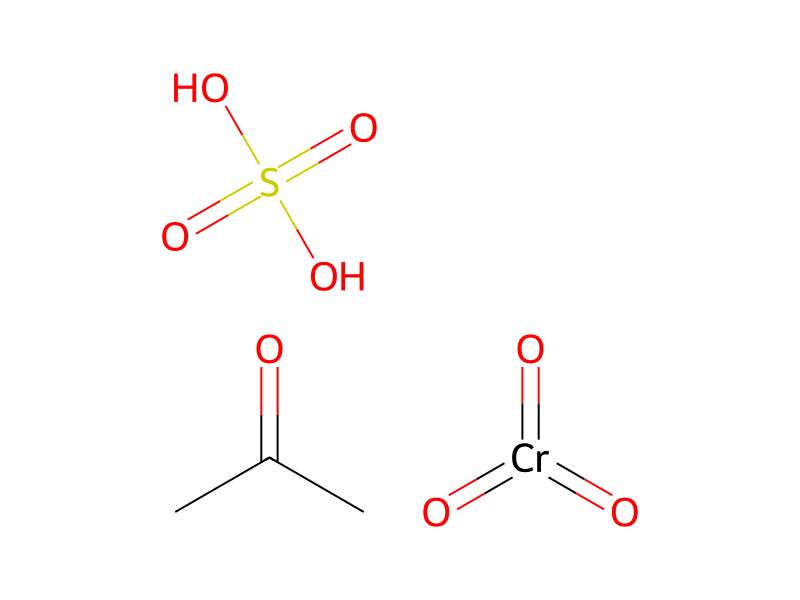
Produkt 1

Reagenzien, Katalysatoren, Lösungsmittel 1

Versuchsvorschrift
To a solution of 3,17β-dihydroxyestra-1,3,5(10)-triene-2-carboxaldehyde (2a, 0.300 g, 1.0 mmol) in acetone (20 mL) was added Jones reagent (0.5 mL) at 0° C. The reaction mixture was stirred for 5 min, then quenched with 2-propanol, and extracted with EtOAc. The combined organic layers were washed with H2O, then with saturated aqueous NaCl, and dried (MgSO4). The desiccant was filtered and the solvent was evaporated at reduced pressure. The residue was purified by column chromatography (silica gel) using n-hexane:THF (4:1→3:1, v/v) to approximately 0.185 g of 5 (62% yield), m.p. 154°-157° C.