Reaktionsgleichung

[Br:1][C:2]1[CH:3]=[C:4]([CH:6]=[CH:7][CH:8]=1)[NH2:5].Cl[C:10]1[C:19]2[C:14](=[CH:15][CH:16]=[C:17]([N+:20]([O-:22])=[O:21])[CH:18]=2)[N:13]=[CH:12][N:11]=1>C(O)(C)C>[Br:1][C:2]1[CH:3]=[C:4]([NH:5][C:10]2[C:19]3[C:14](=[CH:15][CH:16]=[C:17]([N+:20]([O-:22])=[O:21])[CH:18]=3)[N:13]=[CH:12][N:11]=2)[CH:6]=[CH:7][CH:8]=1Komponenten
4
Edukt 2

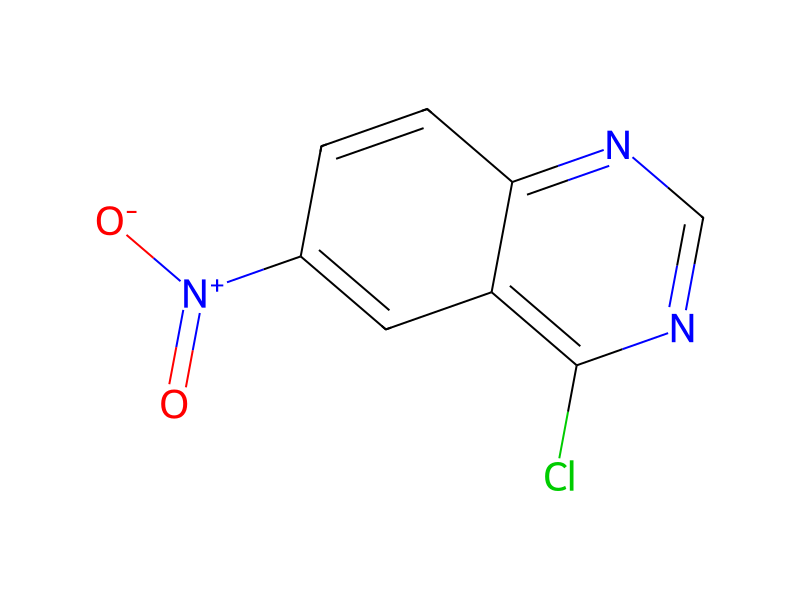
Produkt 1

Reagenzien, Katalysatoren, Lösungsmittel 1

Versuchsvorschrift
3-Bromoaniline (1.72 grams, 10 mmol) was reacted with 4-chloro-6-nitroquinazoline (523 mg, 2.5 mmol), in iso-propylalcohol, as is described hereinabove, to give 4-[(3-bromophenyl)amino]-6-nitroquinazoline (823 mg, 95% yield), which was thereafter reacted (590 mg, 1.7 mmol) with hydrazine hydrate, according to the procedure described hereinabove, to give 4-[(3-bromophenyl)amino]-6-aminoquinazoline (332 mg, 62% yield).
Quellen und Nachweise
- ORD-Eintrag
- ord-6b124bb44fff450f8df54ca562c21af8
- Quelldatensatz
- uspto-grants-2007_02
- Patentnummer
- US07172749B2
Verknüpfte Notizen
Wird geladen…