3-Bromoaniline → N-(3-Bromophenyl)-6-nitroquinazolin-4-amine
HRID 346429
Reaktionsgleichung

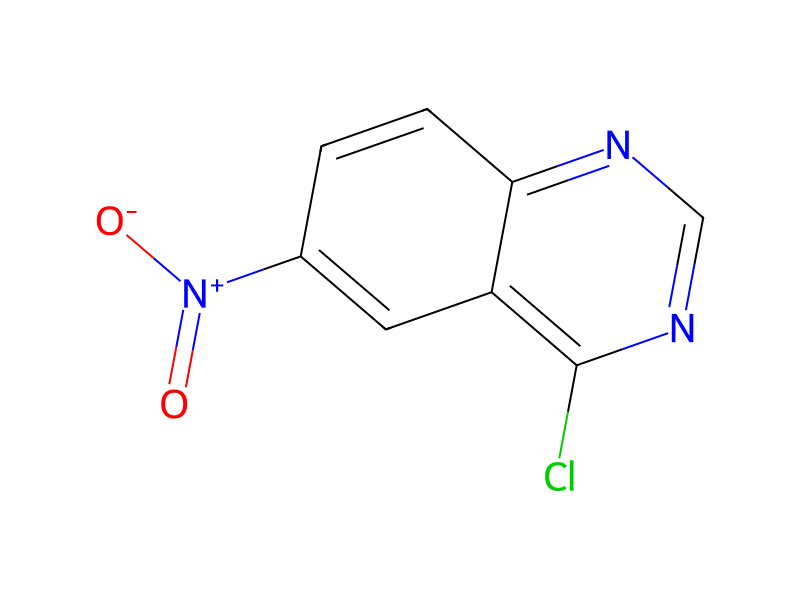
[Br:1][C:2]1[CH:3]=[C:4]([CH:6]=[CH:7][CH:8]=1)[NH2:5].Cl[C:10]1[C:19]2[C:14](=[CH:15][CH:16]=[C:17]([N+:20]([O-:22])=[O:21])[CH:18]=2)[N:13]=[CH:12][N:11]=1>>[Br:1][C:2]1[CH:3]=[C:4]([NH:5][C:10]2[C:19]3[C:14](=[CH:15][CH:16]=[C:17]([N+:20]([O-:22])=[O:21])[CH:18]=3)[N:13]=[CH:12][N:11]=2)[CH:6]=[CH:7][CH:8]=1Komponenten
3


Versuchsvorschrift
3-Bromoaniline was coupled with 4-chloro-6-nitroquinazoline, to produce 4-[(3-bromophenyl)amino]-6-nitroquinazoline, which was reduced thereafter to the corresponding 6-aminoquinazoline. 4-[3-Bromophenyl)amino]-6-aminoquinazoline (300 mg, 0.95 mmol) was dissolved in dry THF (20 ml) and bistributyltin (1.92 ml, 3.78 mmol), followed by tetrakis(triphenylphosphine)palladium (547.8 mg, 0.474 mmol) in dry THF (0.5 ml), were then added and the reaction mixture was gently refluxed for 16 hours. Evaporation of the solvent, followed by purification on aluminium oxide 90 column (70–230 mesh), using a gradient eluent of from 20:80 hexane:dichloromethane to 100% dichloromethane gave the stanylated product 4-[(3-tributyltinphenyl)amino]-6-aminoquinazoline (85 mg, 20% yield). MS (m/z): 527 (M+2H)+; 1H-NMR (CDCl3): δ=0.91 (t, 9H), 1.07 (t, 6H), 1.31 (dt, 6H), 1.58 (mt, 6H), 6.95 (d, 1H), 7.19 (d, 1H), 7.22 (d, 1H), 7.37 (dd, 1H), 7.66 (d, 1H), 7.74 (d, 1H) 8.59 (s, 1H), 10.42 ppm.