2-Bromophenyl isocyanate → methyl 4-[N'-(2-bromophenyl)ureido]-3-chlorophenylacetate
HRID 350442
Reaktionsgleichung

[NH2:1][C:2]1[CH:7]=[CH:6][C:5]([CH2:8][C:9]([O:11][CH3:12])=[O:10])=[CH:4][C:3]=1[Cl:13].[Br:14][C:15]1[CH:20]=[CH:19][CH:18]=[CH:17][C:16]=1[N:21]=[C:22]=[O:23]>C1COCC1>[Br:14][C:15]1[CH:20]=[CH:19][CH:18]=[CH:17][C:16]=1[NH:21][C:22](=[O:23])[NH:1][C:2]1[CH:7]=[CH:6][C:5]([CH2:8][C:9]([O:11][CH3:12])=[O:10])=[CH:4][C:3]=1[Cl:13]Komponenten
4
Edukt 2

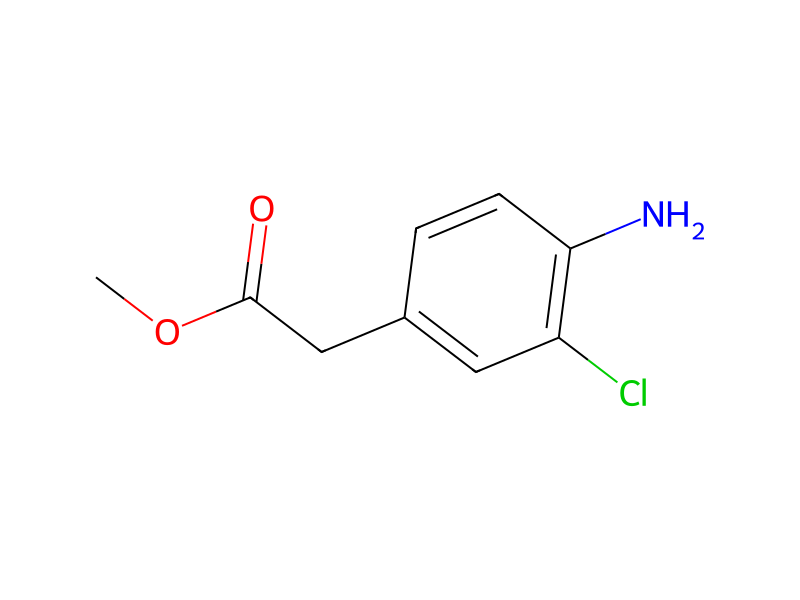
Produkt 1

Reagenzien, Katalysatoren, Lösungsmittel 1

Versuchsvorschrift
To a mixture of methyl 4-amino-3-chlorophenylacetate (1.00 g, 5.01 mmol) and 2-bromophenyl isocyanate (0.62 ml, 5.01 mmol) in THF (20 ml) was added Et3 N (0.14 ml, 1.00 mmol) at room temperature. After 1 day stirring, 2-bromophenyl isocyanate (0.60 ml, 5.01 mmol) was added to the reaction mixture and stirred 24 h. The reaction mixture was concentrated in vacuo. The residue was triturated by the addition of n-hexane to give methyl 4-[N′-(2-bromophenyl)ureido]-3-chlorophenylacetate (1.34 g, 67%) as a colorless powder. 1H-NMR (CDCl3) δ 3.58 (s, 3H), 3.70 (s, 2H), 6.98 (m, 3H), 7.19 (dd, J=8.3, 1.9 Hz, 1H), 7.32 (m, 1H), 7.51 (m, 2H), 8:05 (m, 1H); MS (ESI) m/z 398 (M++1), 400 (M++3), 402 (M++5).