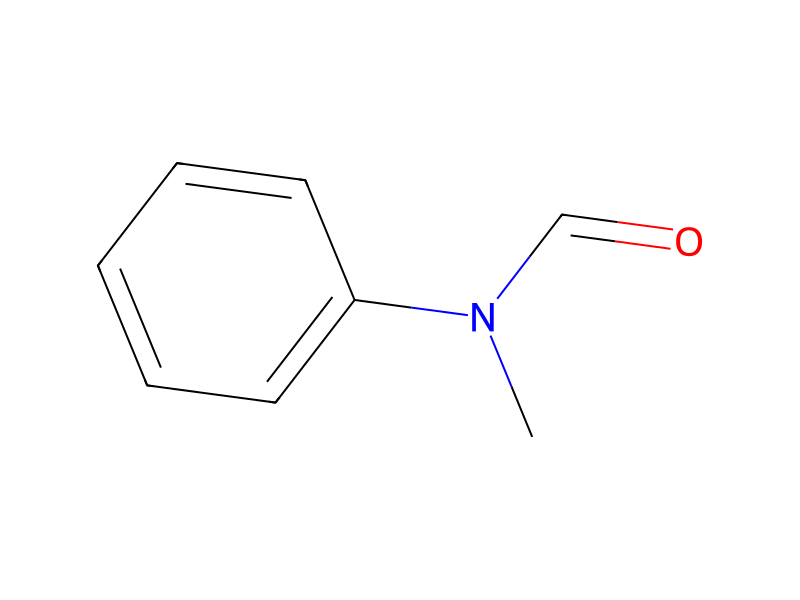
O=P(Cl)(Cl)Cl.CN([CH:14]=[O:15])C1C=CC=CC=1.[CH2:16]([O:23][C:24]1[CH:29]=[CH:28][CH:27]=[C:26]([O:30][CH2:31][C:32]2[CH:37]=[CH:36][CH:35]=[CH:34][CH:33]=2)[C:25]=1[O:38][CH2:39][C:40]1[CH:45]=[CH:44][CH:43]=[CH:42][CH:41]=1)[C:17]1[CH:22]=[CH:21][CH:20]=[CH:19][CH:18]=1>CN(C=O)C>[CH2:31]([O:30][C:26]1[C:25]([O:38][CH2:39][C:40]2[CH:45]=[CH:44][CH:43]=[CH:42][CH:41]=2)=[C:24]([O:23][CH2:16][C:17]2[CH:18]=[CH:19][CH:20]=[CH:21][CH:22]=2)[CH:29]=[CH:28][C:27]=1[CH:14]=[O:15])[C:32]1[CH:33]=[CH:34][CH:35]=[CH:36][CH:37]=1Kolonits, P. et al., Acta Chim. Hung. 113:367 (1983). POCl3 (155 mL, 1.66 mol) was slowly added to N-methylformanilide (175 mL, 1.4 mol) at room temperature under Ar which resulted in formation of a yellow solid. After 2 h, the solid was treated with a solution of 1,2,3-tribenzyloxybenzene 8 (20 g, 51 mmol) in anhydrous DMF (40 mL) and heated to 60° C. After 3 h, the resulting crimson solution was cooled to room temperature and then poured into ice water (3 L) with vigorous stirring for 12 h. The resulting brown precipitate was filtered, washed with hexanes (3×100 mL) and finally recrystallized from MeOH to afford 10 (19.8 g, 93%) as a white powder. mp 73-74° C. 1H NMR (CDCl3): δ10.11 (s, 1 H), 7.57 (d, J=9 Hz, 1 H), 7.44-7.28 (m, 15 H), 6.83 (d, J=9 Hz, 1 H), 5.21(s, 2 H), 5.16 (s, 2 H), 5.08 (s, 2 H); 13C NMR (CDCl3): δ188.8, 158.5, 155.9, 141.1, 136.9, 136.2, 135.8, 128.6, 128.5 (2), 128.3 (2) 128.2, 127.5, 124.0, 109.1, 76.8, 75.5, 70.9. Anal. Calcd for C28H24O4: C, 79.22; H, 5.70. Found: C, 79.17; H, 5.80. HRMS (FAB) calcd for C28H24O4 (M+H+): 424.1675. Found: 424.1669.