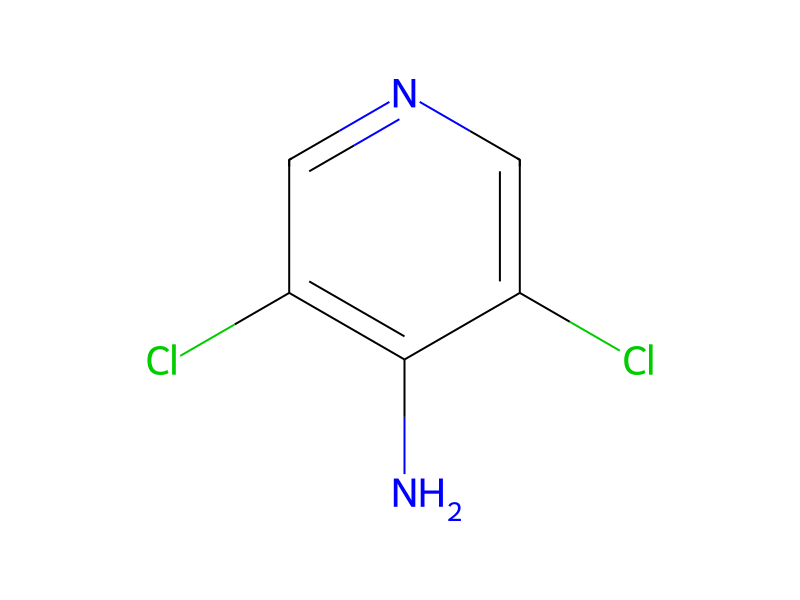
A suspension of sodium hydride (60% dispersion in oil; 2.2 g) in dry tetrahydrofuran (25 mL) at 15°-20° C. is treated portionwise with a solution of 4-amino-3,5-dichloropyridine (4.5 g; that is prepared as described in Reference Example 5) in dry tetrahydrofuran (40 mL), with cooling. The mixture is stirred for a further 30 minutes, and then it is cooled to 10° C. and treated with a solution of 3-cyclopentyloxy-4-methoxybenzoyl chloride (6.4 g) in dry tetrahydrofuran (40 mL), dropwise, during 45 minutes at 10° C. The mixture is stirred at 10° C. for 30 minutes and is then treated with dilute hydrochloric acid (50 mL; 1 N), followed by dichloromethane (75 mL). The layers are separated and the aqueous layer is washed with a further quantity of dichloromethane (25 mL). The combined organic layers are washed with water (50 mL), with saturated aqueous sodium bicarbonate solution (100 mL), and with water (50 mL), dried over magnesium sulfate and evaporated to dryness. The resulting residue is recrystallized from isopropanol, to give N-(3,5-dichloropyrid-4-yl)-3-cyclopentyloxy-4-methoxybenzamide (7.0 g).