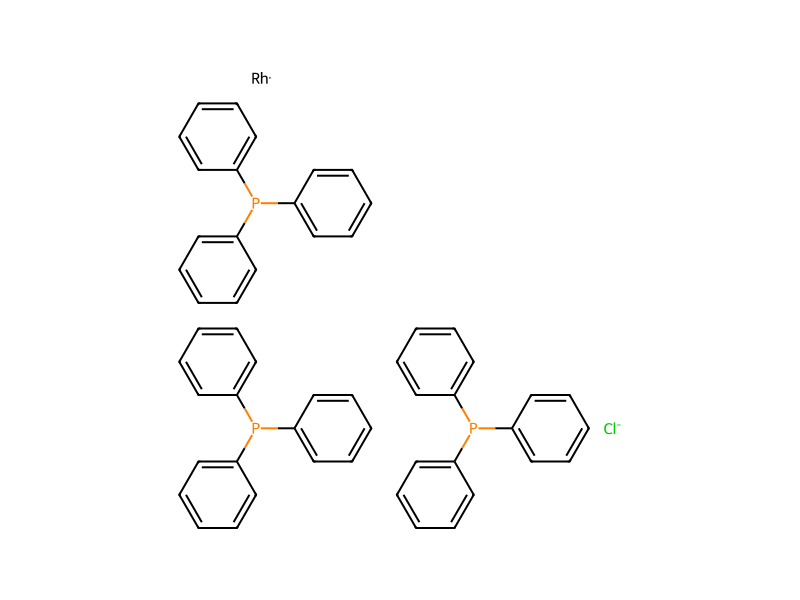
A warmed solution of 4-ethylidene-8-methoxy-3,4-dihydro-1H-pyrano[3,4-c]pyridine, prepared as in example 3 (0.35 g, 1.83 mmol) in 30 mL of n-propanol is purged with a stream of nitrogen for 20 minutes prior to the addition of tris(triphenylphosphine)rhodium(I) chloride (0.025 g, 0.027 mmol). The reaction mixture is stirred at reflux for 15 hours under nitrogen and again treated with tris(triphenylphosphine)rhodium(I) chloride (0.025 g). After 2 hr, the flask is charged with potassium carbonate (0.50 g, 3.60 mmol), and heated for 2 hr. The mixture is then treated with tris(triphenylphosphine)rhodium(I) chloride (0.025 g). The mixture is heated to reflux for an additional 2 hr, filtered through Celite 545® and the filtrate is concentrated in vacuo. 1H NMR analysis shows an 1:8.3 ratio of exo-(4-ethylidene-8-methoxy-3,4-dihydro-1H-pyrano[3,4-c]pyridine) to endocyclic (4-ethyl-8-methoxy-1H-pyrano[3,4-c]pyridine) product. The dark residue is chromatographed on silica gel using 5% EtOAc/hexanes to provide 4-ethyl-8-methoxy-1H-pyrano[3,4-c]pyridine, the endocyclic form, as a colorless oil. 1H-NMR (CDCl3, 400 MHz): δ1.13 (t, J=7.4 Hz, 3H, --CH3); 2.30 (q, J=7.4 Hz, 2H, --CH2 --); 3.95 (s, 3H, --OCH3); 5.04 (s, 2H, --CH2O); 6.55 (d, J=5.4 Hz, 1H, Aromatic); 8.04 (d, J=5.4 Hz, Aromatic). Anal. Calcd for C11H13NO2.0.10CHCl3.0.05C3H8O: C, 65.54; H, 6.60; N,6.79. Found: C, 65.48; H, 6.57; N, 6.89. Mass Spectrum (FAB+): m/e 192 (M+1,100%).