HuagongsheHuagongshe Chemie-Druckbericht · Nur für Forschungszwecke
HRID 3656Erstellt: 24. Oktober 2026
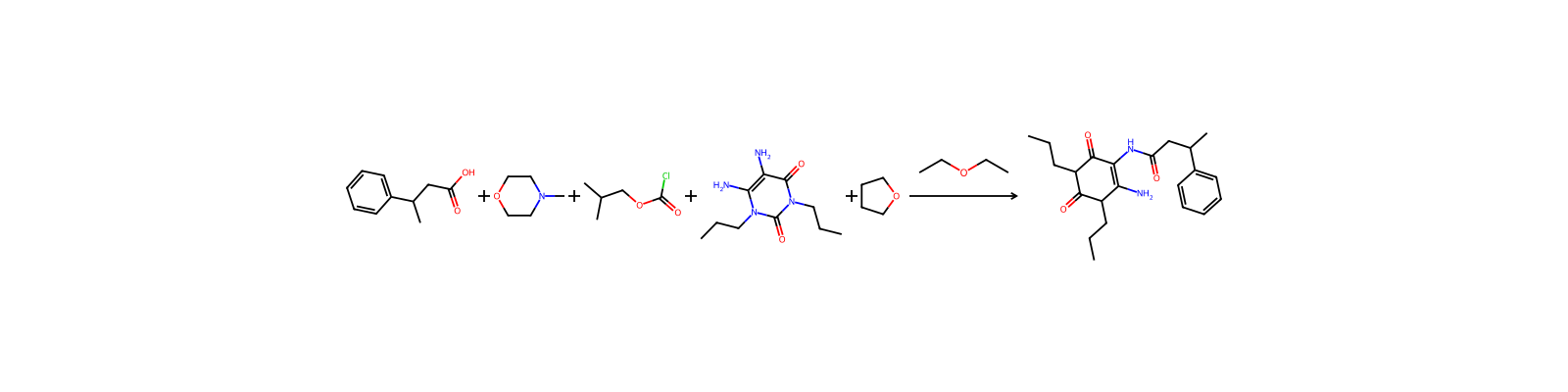
4-Methylmorpholine → N-(2-amino-4,6-dioxo-3,5-dipropylcyclohex-1-enyl)-3-phenylbutyramide
https://huagongshe.com/de/reaction/3656
Beteiligte Stoffe
| Rolle | Name | HCID | Einwaage |
|---|
| Edukt | 4-Methylmorpholine | HCID 7972 | — |
| Edukt | Tetrahydrofuran | HCID 8028 | — |
| Edukt | 3-Phenylbutyric acid | HCID 20724 | — |
| Edukt | Isobutyl chloroformate | HCID 62365 | — |
| Edukt | 5,6-Diamino-1,3-dipropyl-2,4(1H,3H)-pyrimidinedione | HCID 5098605 | — |
| Lösungsmittel | Diethyl Ether | HCID 3283 | — |
| Produkt | N-(2-amino-4,6-dioxo-3,5-dipropylcyclohex-1-enyl)-3-phenylbutyramide | HCID 18935170 | — |
Reaktionsschritte
Dissolve 3-phenylbutyric acid (1.0 g, 6.1 mmol) in tetrahydrofuran (20 ml), treat with N-methylmorpholine (0.67 ml, 6.1 mmol) and cool to -20° C. Add isobutyl chloroformate (0.79 ml, 6.1 mmol) and stir for 20 minutes. Then add 1,3-di-n-propyl-5,6-diaminouracil (1.4 g, 6.1 mmol, in 5 ml dimethylformamide) and stir the reaction at -20° C. for 3 hours. Then dilute the reaction with diethyl ether (400 ml) and separate the layers. Rinse the organic layer with saturated sodium bicarbonate (200 ml), 50% aqueous sodium chloride (2×200 ml), dry over anhydrous magnesium sulfate, filter and concentrate under vacuum to provide N-(2-amino-4,6-dioxo-3,5-dipropylcyclohex-1-enyl)-3-phenylbutyramide (2.23 g).
Herkunft & Nachweise
| DOI | 10.6084/m9.figshare.5104873.v1 |
|---|
| Patentnummer | US05734052 |
|---|
| Quelldatensatz | uspto-grants-1998_03 |
|---|
| ORD ID | ord-a89a3e5e7d9441a2aad27464a69c6f6b |
|---|
| Quellennotiz | uspto-grants-1998_03 |
|---|