Reaktionsgleichung
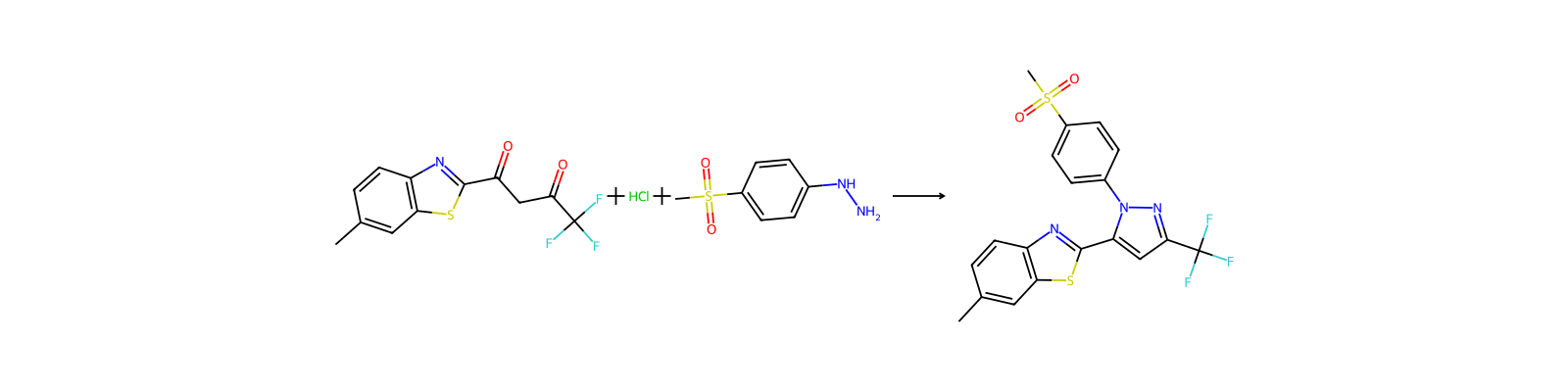
[CH3:1][C:2]1[CH:19]=[CH:18][C:5]2[N:6]=[C:7]([C:9](=O)[CH2:10][C:11](=O)[C:12]([F:15])([F:14])[F:13])[S:8][C:4]=2[CH:3]=1.Cl.[CH3:21][S:22]([C:25]1[CH:30]=[CH:29][C:28]([NH:31][NH2:32])=[CH:27][CH:26]=1)(=[O:24])=[O:23]>>[CH3:1][C:2]1[CH:19]=[CH:18][C:5]2[N:6]=[C:7]([C:9]3[N:31]([C:28]4[CH:27]=[CH:26][C:25]([S:22]([CH3:21])(=[O:24])=[O:23])=[CH:30][CH:29]=4)[N:32]=[C:11]([C:12]([F:15])([F:14])[F:13])[CH:10]=3)[S:8][C:4]=2[CH:3]=1Komponenten
3


Versuchsvorschrift
The procedure of Example 9 was repeated using 1-(6-methylbenzothiazol-2-yl)-4,4,4-trifluorobutane-1,3-dione and 4-methylsulfonylphenylhydrazine hydrochloride as the starting materials to obtain 6-methyl-2-[1-(4-methylsulfonylphenyl)-3-trifluoromethyl-1H-pyrazol-5-yl]benzothiazole (yield, 47%).
Quellen und Nachweise
- ORD-Eintrag
- ord-aed63c40e69b48dd8503aab103eb26bc
- Quelldatensatz
- uspto-grants-2000_10
- Patentnummer
- US06136831
Verknüpfte Notizen
Wird geladen…