2,3-Dichloro-5,6-dicyano-1,4-benzoquinone → 2-Bromo-1-naphthaldehyde
Reaktionsgleichung
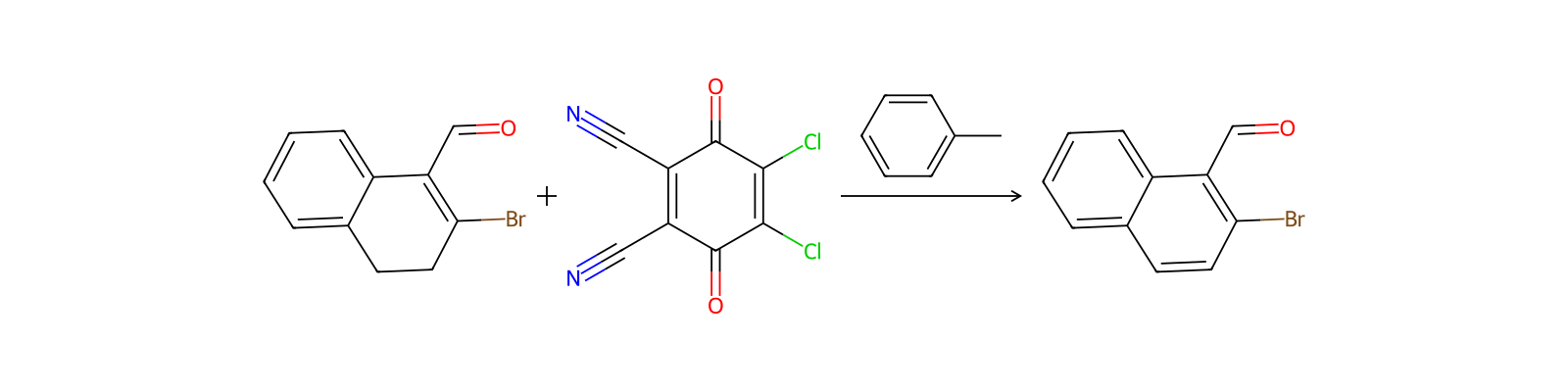
[Br:1][C:2]1[CH2:11][CH2:10][C:9]2[C:4](=[CH:5][CH:6]=[CH:7][CH:8]=2)[C:3]=1[CH:12]=[O:13].C(C1C(=O)C(Cl)=C(Cl)C(=O)C=1C#N)#N>C1(C)C=CC=CC=1>[Br:1][C:2]1[CH:11]=[CH:10][C:9]2[C:4](=[CH:5][CH:6]=[CH:7][CH:8]=2)[C:3]=1[CH:12]=[O:13]Komponenten
4
Edukt 2


Produkt 1

Reagenzien, Katalysatoren, Lösungsmittel 1

Versuchsvorschrift
2-Bromo-6,7-dimethoxy-1-napthaldehyde (10). Dimethylformamide (3.0 g, 41 mmol) was added dropwise to solution of phosphorus tribromide (3.3 mL, 35 mmol) in dry chloroform (50 mL) at 0° C. The mixture was stirred at 0° C. for 1 h to give pale yellow suspension. A solution of compound 8 (2.0 g, 9.7 mmol) in chloroform was added to the yellow suspension and the mixture was heated at reflux for 1 h. The reaction mixture was cooled to 0° C. and saturated aqueous NaHCO3 solution was added dropwise until no effervescence was obtained. The resulting mixture was extracted with dichloromethane, dried (Na2SO4) and evaporated to provide the respective 2-bromo-3,4-dihydro-1-napthaldehyde derivatives as yellow solids. Each of the 2-bromo-3,4-dihydro-1-napthaldehyde derivatives were chromatographed on silica gel using a 3:1 mixture of hexanes:ethyl acetate as the eluent to give the 2-bromo-3,4-dihydro-1-napthaldehydes in an 87% yield. The 2-bromo-3,4-dihydro-1-napthaldehyde (2.4 g, 8.1 mmol) and DDQ (2.2 g, 97 mmol) was refluxed in toluene (50 mL) for 15 h. After cooling to room temperature, the mixture was subjected to filtration through a celite bed and the filtrate was evaporated to dryness. The residue obtained was chromatographed on 75 g silica gel using a 3:1 mixture of hexanes:ethyl acetate as eluent to give the 2-bromo-1-napthaldehyde in a 95% yield; 1H NMR δ 4.00 (3H, s), 4.05 (3H, s), 7.07 (1H, s), 7.54 (1H, d, J=8.5), 7.79 (1H, d, J=8.5), 8.71 (1H, s), 10.74 (1H, s); 13C NMR δ 56.3, 56.6, 104.2, 107.0, 126.5, 128.8, 129.4, 129.8, 129.9, 134.3, 150.4, 153.1, 195.9; HRMS calcd for C,3H11O3Br: 293.9891; found: 293.9896.