HuagongsheHuagongshe Chemie-Druckbericht · Nur für Forschungszwecke
HRID 37585Erstellt: 24. Oktober 2026
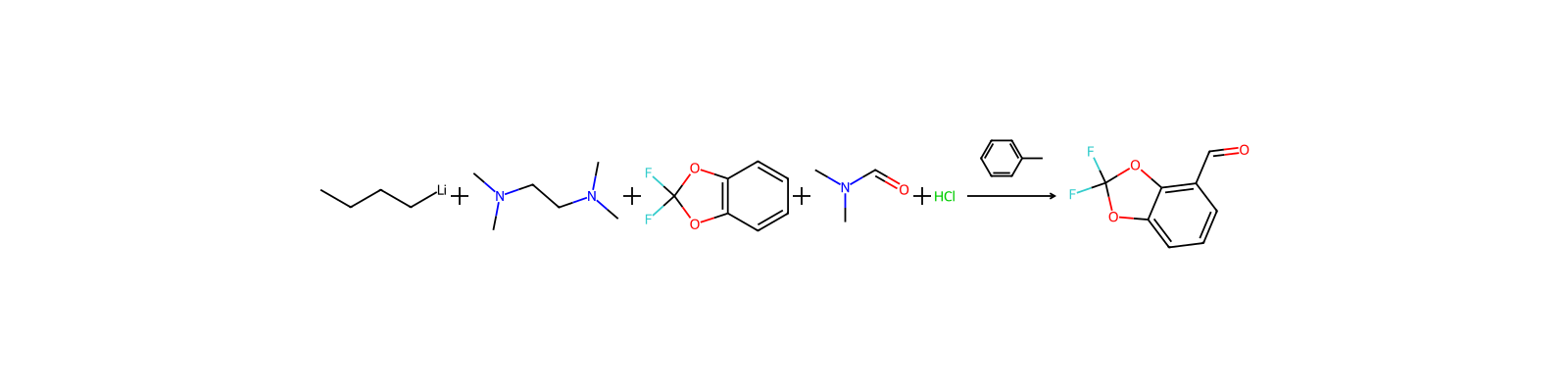
Hydrochloric Acid → 2,2-Difluoro-benzo(1,3)dioxole-4-carbaldehyde
https://huagongshe.com/de/reaction/37585
Beteiligte Stoffe
| Rolle | Name | HCID | Einwaage |
|---|
| Edukt | Hydrochloric Acid | HCID 313 | — |
| Edukt | Dimethylformamide | HCID 6228 | — |
| Edukt | N,N,N',N'-Tetramethylethylenediamine | HCID 8037 | — |
| Edukt | 2,2-Difluoro-1,3-benzodioxole | HCID 74103 | — |
| Edukt | Butyllithium | HCID 178418339 | — |
| Lösungsmittel | Toluene | HCID 1140 | — |
| Produkt | 2,2-Difluoro-benzo(1,3)dioxole-4-carbaldehyde | HCID 2736970 | — |
Reaktionsschritte
94.0 g (272 mmol) of n-butyllithium (18.5% in toluene) are added dropwise under a nitrogen atmosphere, at from -15° to -10° C., over a period of 1.5 hours, to 29.5 g (254 mmol) of N,N,N',N'-tetramethylethylenediamine and 40.0 g (253 mmol) of 2,2-difluoro-1,3-benzodioxole in 35 ml of toluene, an orange suspension being formed. 19.7 g (270 mmol) of DMF are then metered in at from -15° to -10° C. over a period of 1/2 hour. The pale yellow suspension is poured at +10° C. onto 346 g (1.105 mol) of 11.6% aqueous hydrochloric acid and the whole is stirred for 1/2 hour to complete the reaction. The aqueous phase is separated off and the organic phase is concentrated by evaporation in a vacuum rotary evaporator at 50° C./200 mbar under nitrogen to yield the desired product.
Herkunft & Nachweise
| DOI | 10.6084/m9.figshare.5104873.v1 |
|---|
| Patentnummer | US05420301 |
|---|
| Quelldatensatz | uspto-grants-1995_05 |
|---|
| ORD ID | ord-3eca32ec96e34b94909277e13a1f16e0 |
|---|
| Quellennotiz | uspto-grants-1995_05 |
|---|