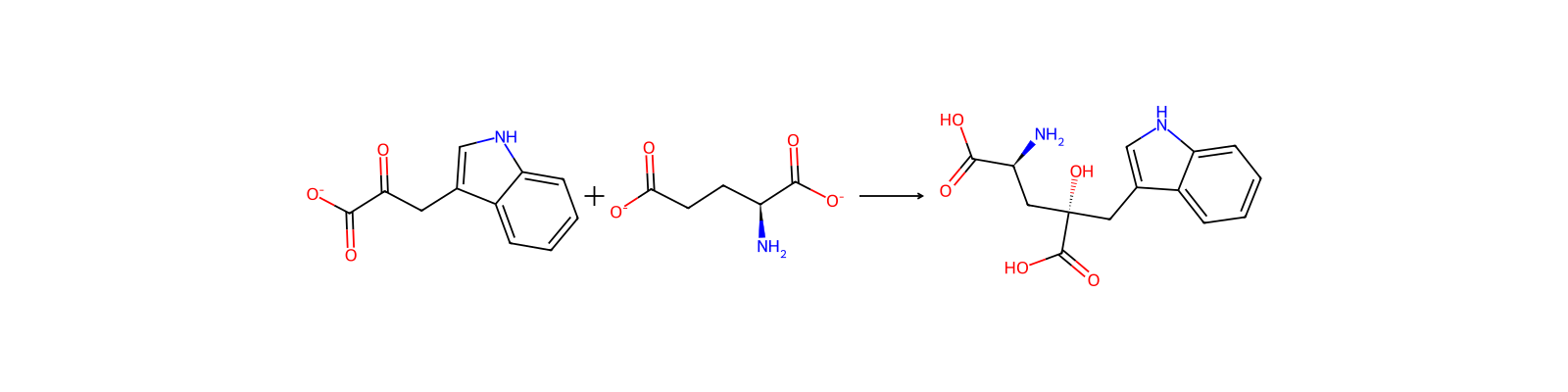
Beteiligte Stoffe
| Rolle | Name | HCID | Einwaage |
|---|
| Edukt | 3-(1H-Indol-3-yl)-2-oxopropanoate | HCID 5460337 | — |
| Edukt | L-glutamate(2-) | HCID 5460544 | — |
| Produkt | Monatin | HCID 9860847 | — |
Reaktionsschritte
The KHG aldolases from B. subtilis, E. coli, and S. meliloti were also used with the E. coli L-aspartate aminotransferase to produce monatin enzymatically. The following reaction conditions were used: 50 mM NH4—OAc pH 8.3, 2 mM MgCl2, 200 mM pyruvate, 5 mM glutamate, 0.05 mM pyridoxal phosphate, deaerated water to achieve a final volume of 0.5 mL after the addition of the enzymes, 3 mM potassium phosphate, 20 μg/mL of recombinant B. subtilis KHG aldolase (purified), ca. 400 μg/mL of E. coli L-aspartate aminotransferase (AspC) unpurified from cell extract, and 12 mM indole-3-pyruvate. The reactions were incubated at 30° C. for 30 minutes with shaking. The amount of monatin produced using the B. subtilis enzyme was 80 ng/mL, and increased with increasing amounts of aldolase. If indole-3-pyruvate and glutamate were replaced by saturating amounts of tryptophan and 5 mM alpha-ketoglutarate, the production of monatin was increased to 360 ng/mL. Reactions were repeated with 30 μg/mL of each of the three KHG enzymes in 50 mM Tris pH 8.3, with saturating amounts of tryptophan, and were allowed to proceed for an hour in order to increase detection. The Bacillus enzyme had the highest activity as in Example 4, producing approximately 4000 ng/mL monatin. The E. coli KHG produced 3000 ng/mL monatin, and the S. meliloti enzyme produced 2300 ng/mL.
Herkunft & Nachweise
| DOI | 10.6084/m9.figshare.5104873.v1 |
|---|
| Patentnummer | US08372989B2 |
|---|
| Quelldatensatz | uspto-grants-2013_02 |
|---|
| ORD ID | ord-3d57dfb7701344fdb6fe34a1a9e36e90 |
|---|
| Quellennotiz | uspto-grants-2013_02 |
|---|