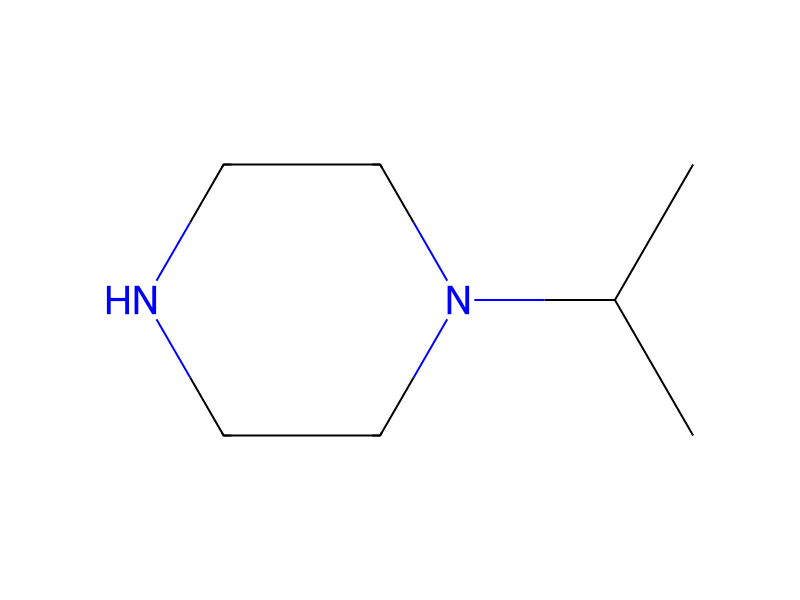
1-Isopropylpiperazine → 6-Bromo-1-methyl-4-(5-{[4-(1-methylethyl)-1-piperazinyl]methyl}-1,3,4-oxadiazol-2-yl)-1H-indazole
HRID 38833
Reaktionsgleichung

[Br:1][C:2]1[CH:10]=[C:9]2[C:5]([CH:6]=[N:7][N:8]2[CH3:11])=[C:4]([C:12]2[O:13][C:14]([CH2:17]Cl)=[N:15][N:16]=2)[CH:3]=1.[CH3:19][CH:20]([N:22]1[CH2:27][CH2:26][NH:25][CH2:24][CH2:23]1)[CH3:21]>>[Br:1][C:2]1[CH:10]=[C:9]2[C:5]([CH:6]=[N:7][N:8]2[CH3:11])=[C:4]([C:12]2[O:13][C:14]([CH2:17][N:25]3[CH2:26][CH2:27][N:22]([CH:20]([CH3:21])[CH3:19])[CH2:23][CH2:24]3)=[N:15][N:16]=2)[CH:3]=1Komponenten
3


Reaktionsbedingungen
- Temperatur
- 90 °C
Versuchsvorschrift
6-Bromo-4-[5-(chloromethyl)-1,3,4-oxadiazol-2-yl]-1-methyl-1H-indazole (260 mg, 0.794 mmol) and 1-(1-methylethyl)piperazine (1.5 ml, 0.794 mmol) were added to a microwave vial. The reaction mixture was heated under microwave irradiation at 90° C. for 15 mins. The reaction mixture was evaporated under a stream of nitrogen, dissolved in DCM (20 ml) and washed with a 10% solution of 2M hydrochloric acid in water. The layers were separated by hydrophobic frit and the aqueous layer was neutralised to pH=7 with 2M sodium hydroxide then extracted with DCM (20 ml). The organic layer was collected and the solvent removed in vacuo to give the title compound as an orange solid (310 mg).