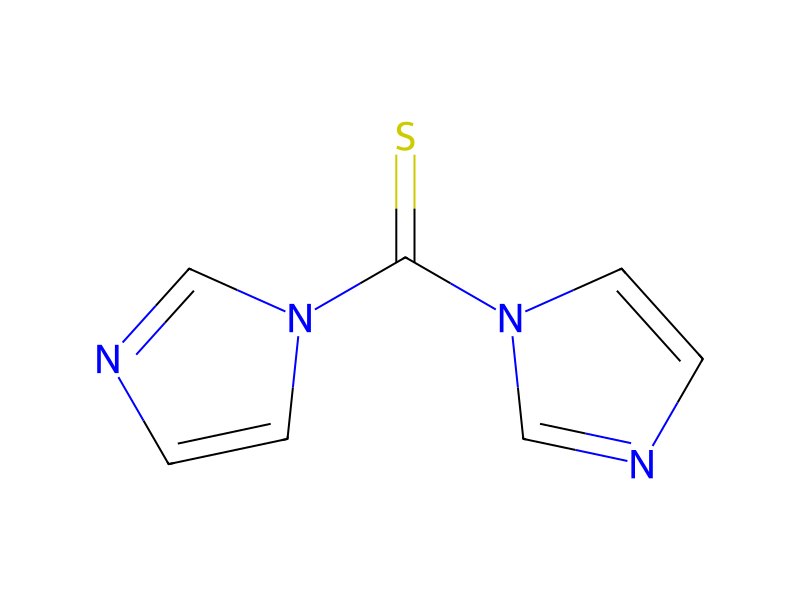
[C:1]([O:4][CH2:5][CH2:6][CH2:7][NH:8][C:9]1[C:18]2[C:13](=[CH:14][C:15]([Br:19])=[CH:16][CH:17]=2)[N:12]=[CH:11][C:10]=1[NH2:20])(=[O:3])[CH3:2].O1CCCC1.[C:26](N1C=CN=C1)(N1C=CN=C1)=[S:27]>ClCCl>[C:1]([O:4][CH2:5][CH2:6][CH2:7][N:8]1[C:9]2[C:18]3[CH:17]=[CH:16][C:15]([Br:19])=[CH:14][C:13]=3[N:12]=[CH:11][C:10]=2[NH:20][C:26]1=[S:27])(=[O:3])[CH3:2]To a round-bottomed flask containing 3-[(3-amino-7-bromoquinolin-4-yl)amino]propyl acetate (54.5 g, 161.1 mmol) was added anhydrous tetrahydrofuran (THF, 1.4 L), followed by 1,1′-thiocarbonyldiimidazole (31.6 g, 177.3 mmol) and the reaction mixture was stirred at 71° C. for 1.5 h. The reaction was cooled to ambient temperature and the solvent was removed under reduced pressure to afford an oil. The oil was dissolved in dichloromethane (1.3 L) and the solution was washed with water (3×600 mL). During each wash a significant amount of precipitate was observed which was isolated to afford 3-(7-bromo-2-thioxo-2,3-dihydro-1H-imidazo[4,5-c]quinolin-1-yl)propyl acetate (28.9 g) as a light brown solid.