Reaktionsgleichung

[Cl:1][C:2]1[CH:14]=[CH:13][CH:12]=[C:11]([F:15])[C:3]=1[CH2:4][N:5]1[CH2:10][CH2:9][NH:8][CH2:7][CH2:6]1.[NH2:16][C:17]1[C:22]([N+:23]([O-:25])=[O:24])=[C:21](Cl)[C:20]([Cl:27])=[CH:19][N:18]=1>C(O)(C)C>[Cl:27][C:20]1[C:21]([N:8]2[CH2:7][CH2:6][N:5]([CH2:4][C:3]3[C:11]([F:15])=[CH:12][CH:13]=[CH:14][C:2]=3[Cl:1])[CH2:10][CH2:9]2)=[C:22]([N+:23]([O-:25])=[O:24])[C:17]([NH2:16])=[N:18][CH:19]=1Komponenten
Edukt 2
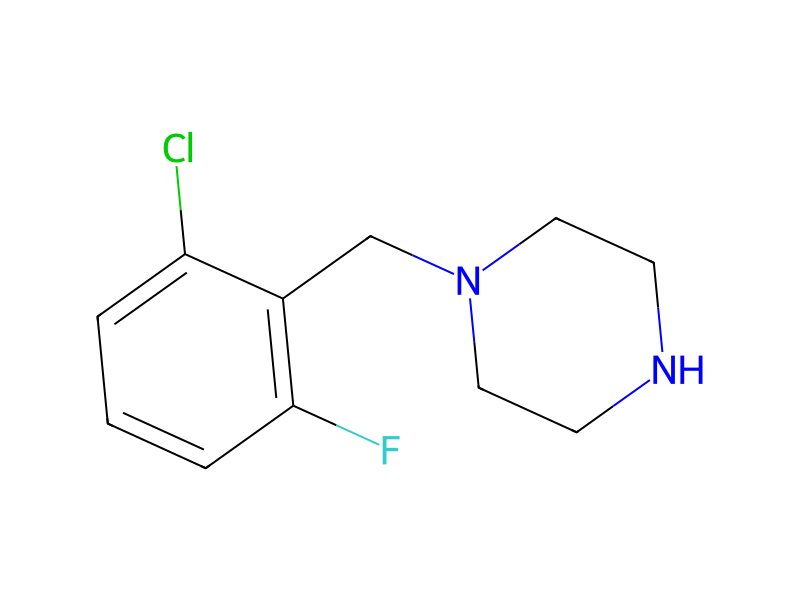

Produkt 1

Reagenzien, Katalysatoren, Lösungsmittel 1

Reaktionsbedingungen
- Temperatur
- 45 °C
Versuchsvorschrift
A mixture of 1-(2-chloro-6-fluorobenzyl)piperazine (0.063 g, 0.28 mmol), isopropanol (4.3 ml), and 2-amino-4,5-dichloro-3-nitropyridine (0.042 g, 0.20 mmol) was heated at 45° C. for 22 h. The reaction mixture was allowed to cool to room temperature, and concentrated in vacuo. The residue was absorbed on silica gel and the free running powder was placed on a 10 g isolute silica column which was eluted first with 30% petroleum ether 60-80° C., and then ethyl acetate. The title compound was obtained as a yellow solid (0.050 g, 62%); 1H-NMR (500 Mz, DMSO-d6) 2.56 (br s, 4H, piperazine N(CH2)2), 3.01 (br s, 4H, piperazine N(CH2)2), 3.66 (s, 2H, NCH2), 6.94 (s, 2H, 2-NH2), 7.23 (t, J=8.91 Hz, 1H) and 7.38 (m, 2H) (ArH), 8.06 (s, 1H, 6-H); LC-MS (ESI, m/z) 4.85 min—400, 402, 404 [(M+H)+, Cl2 isotopic pattern].
Aufarbeitung
- temperatureto cool to room temperature
- concentrationconcentrated in vacuo
- customThe residue was absorbed on silica gel
- washwas eluted first with 30% petroleum ether 60-80° C.
Quellen und Nachweise
- ORD-Eintrag
- ord-fe4819e48d10437488fe34d25a56f14f
- Quelldatensatz
- uspto-grants-2012_01
- Patentnummer
- US08088761B2
Verknüpfte Notizen
Wird geladen…