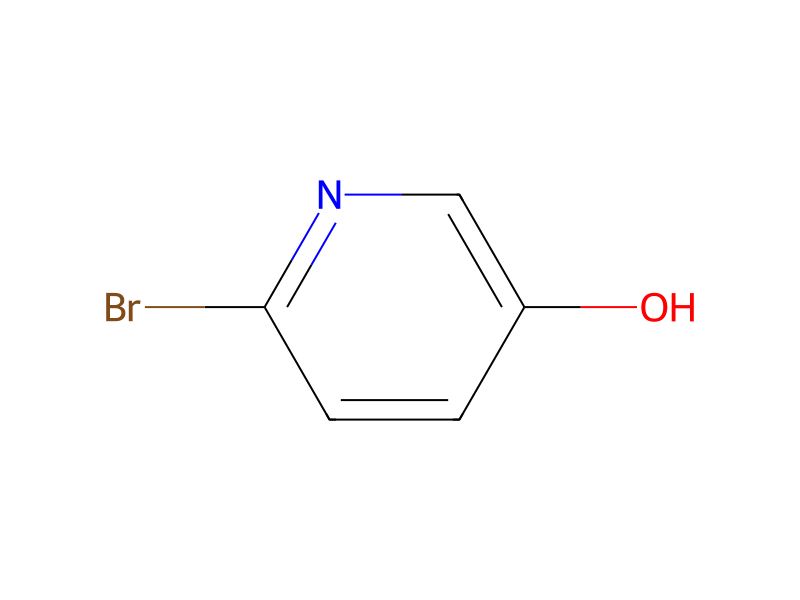
A mixture of Pd(PPh3)2Cl2 (0.42 g, 0.57 mmol) and 2-bromo-5-hydroxypyridine (1.0 g, 5.75 mmol) in DME (20 mL) was degassed with N2. 2M Na2CO3 (10 mL) was added, and the mixture was stirred at ambient temperature for 10 minutes. 4-Bromo-2-fluorobenzeneboronic acid (1.48 g, 6.61 mmol) was added. The reaction mixture was degassed again, purged with N2 and heated at 80° C. overnight, then cooled to ambient temperature, and partitioned between water and EtOAc. Concentrated HCl was added carefully to adjust aqueous pH to about 8, the mixture was filtered thought Celite®, and the EtOAc layer was separated and washed with brine, dried over Na2SO4, filtered, and the filtrate was concentrated to give the crude product as a dark brown oil. The crude product was purified by chromatography on a silica gel column eluted with 20% EtOAc/hexane to give 0.168 g of 6-(4-bromo-2-fluorophenyl)-3-pyridinol as an off-white solid. The impure fractions were combined, concentrated and further purified with 1:5 acetone/hexane to give additional 78 mg of 6-(4-bromo-2-fluorophenyl)-3-pyridinol (0.246 g overall, 16% yield). 1H NMR (400 MHz, CD3OD): δ 8.20 (d, 1H, J=2.7 Hz), 7.75-7.65 (m, 1H), 7.62 (dd, 1H, Ja=8.7 Hz, Jb=2.1 Hz), 7.50-7.40 (m, 2H), 7.28 (dd, 1H, Ja=8.5 Hz, Jb=2.9 Hz); LRMS (ESI), m/z 268/270 (M+H).