2-(3,4-Dimethoxy-5-nitrophenyl)-2-oxoacetaldehyde → 5-(3,4-Dimethoxy-5-nitrophenyl)-3-(2-(trifluoromethyl)pyridin-3-yl)-1,2,4-triazine
HRID 42657
Reaktionsgleichung
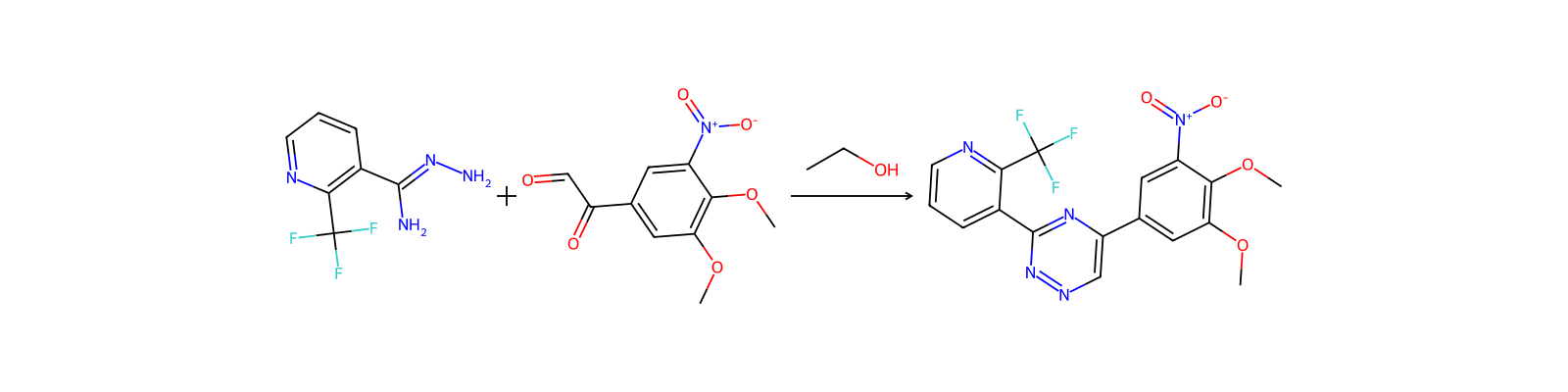
[F:1][C:2]([F:14])([F:13])[C:3]1[N:12]=[CH:11][CH:10]=[CH:9][C:4]=1/[C:5](=[N:7]/[NH2:8])/[NH2:6].[CH3:15][O:16][C:17]1[CH:18]=[C:19]([C:28](=O)[CH:29]=O)[CH:20]=[C:21]([N+:25]([O-:27])=[O:26])[C:22]=1[O:23][CH3:24]>C(O)C>[CH3:15][O:16][C:17]1[CH:18]=[C:19]([C:28]2[N:6]=[C:5]([C:4]3[C:3]([C:2]([F:13])([F:1])[F:14])=[N:12][CH:11]=[CH:10][CH:9]=3)[N:7]=[N:8][CH:29]=2)[CH:20]=[C:21]([N+:25]([O-:27])=[O:26])[C:22]=1[O:23][CH3:24]Komponenten
4
Edukt 2


Produkt 1

Reagenzien, Katalysatoren, Lösungsmittel 1

Versuchsvorschrift
To a stirred solution of (Z)-2-(trifluoromethyl)nicotinohydrazonamide (1.02 g, 5 mmol) in ethanol (30 mL) was added 2-(3,4-dimethoxy-5-nitrophenyl)-2-oxoacetaldehyde (1.19 g, 5 mmol). The reaction mixture was heated to reflux for 5 hours. It was then cooled to room temperature and the solvent was removed by evaporation. The residue was dissolved in dichloromethane (30 mL) and the organic phase was washed with water and dried over anhydrous magnesium sulphate, filtered and evaporated. The crude product was recrystallized from isopropanol to give 5-(3,4-dimethoxy-5-nitrophenyl)-3-(2-(trifluoromethyl)pyridin-3-yl)-1,2,4-triazine, 1.628 g (80%).