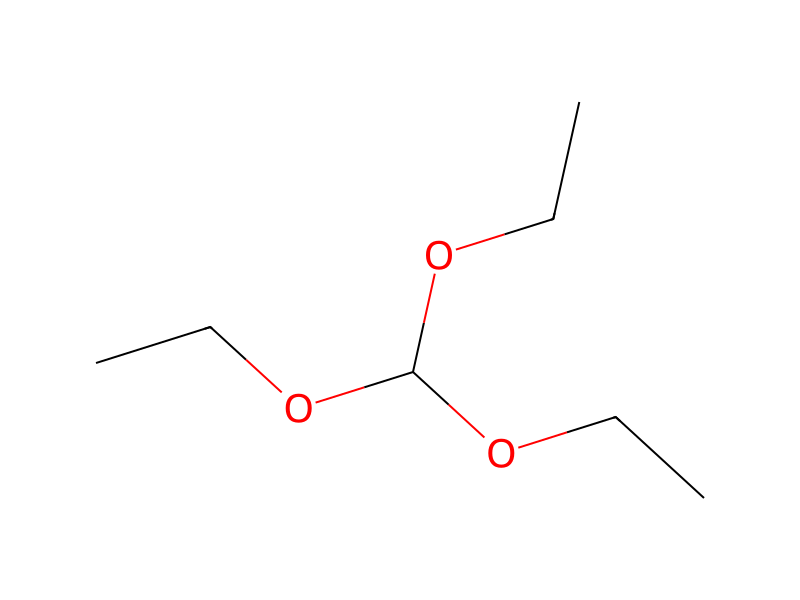
[Br:1][C:2]1[CH:9]=[C:8]([F:10])[CH:7]=[CH:6][C:3]=1C=O.BrC1C=C(F)C=CC=1C.C(O[CH:23]([O:27][CH2:28][CH3:29])[O:24][CH2:25][CH3:26])C.C1(C)C=CC(S(O)(=O)=O)=CC=1>C(O)C.C(=O)([O-])[O-].[Na+].[Na+]>[CH2:28]([O:27][CH:23]([O:24][CH2:25][CH3:26])[C:3]1[CH:6]=[CH:7][C:8]([F:10])=[CH:9][C:2]=1[Br:1])[CH3:29]To a solution of 6.5 g of 2-bromo4-fluoro-benzaldehyde (prepared by the oxidation of 2-bromo-4-fluoro-toluene by the method reported by V. J. Bauer, B. J. Duffy, D. Hoffman, S. S. Klioze, R. W. Kosley, Jr., A. R. McFadden, L. L. Martin, H. H. Ong and H. M. Geyer III, J. Med. Chem., 1976, 19, 1315) in 25 ml of ethanol was added triethylorthoformate followed by 0.05 g of p-toluene sulfonic acid. The solution was stirred at room temperature for 2.25 h then diluted with 100 ml of a 5% sodium carbonate solution and extracted with two 100 ml portions of ether. The combined organic layers were washed with 50 ml of brine and dried over sodium sulfate. Evaporation of the solvent yielded 8.8 g of 2-bromo4-fluoro-benzaldehyde diethyl acetal as an oil, 1H NMR (200 MHz; CDCl3) δH 5.60 (CHO3).