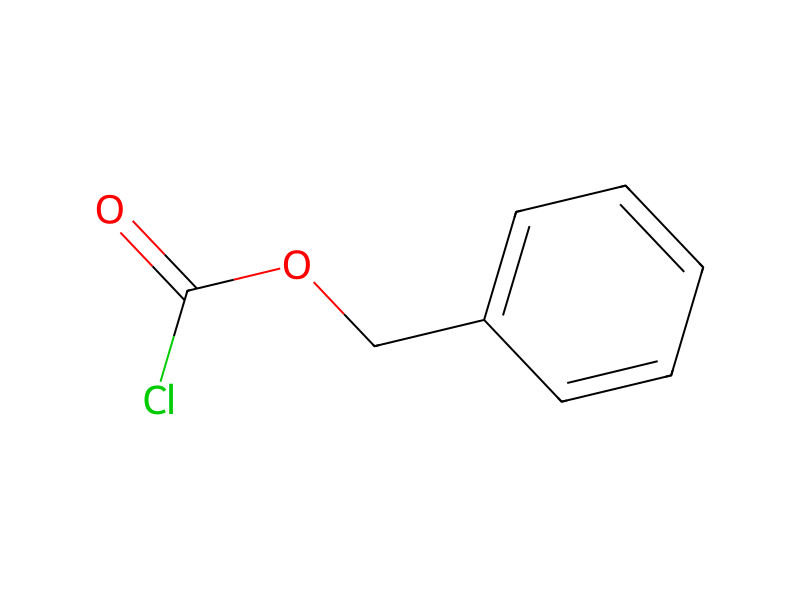
Cl[C:2]([O:4][CH2:5][C:6]1[CH:11]=[CH:10][CH:9]=[CH:8][CH:7]=1)=[O:3].[NH2:12][C:13]1[C:22]2[C:17](=[CH:18][CH:19]=[CH:20][CH:21]=2)[C:16]([CH2:23][C:24]([O:26][CH2:27][CH3:28])=[O:25])=[C:15]([N+:29]([O-:31])=[O:30])[CH:14]=1.CCN(CC)CC>C(Cl)Cl>[CH2:5]([O:4][C:2]([NH:12][C:13]1[C:22]2[C:17](=[CH:18][CH:19]=[CH:20][CH:21]=2)[C:16]([CH2:23][C:24]([O:26][CH2:27][CH3:28])=[O:25])=[C:15]([N+:29]([O-:31])=[O:30])[CH:14]=1)=[O:3])[C:6]1[CH:11]=[CH:10][CH:9]=[CH:8][CH:7]=1Benzyl chloroformate (1.56 mL, 10.94 mmol) was added to a solution of ethyl (4-amino-2-nitronaphthalen-1-yl)acetate (1.0 g, 3.65 mmoml) and Et3N (0.56 mL, 4.01 mmol) in dry CH2Cl2 (20 mL) slowly that was at 0° C. under N2 atmosphere. The mixture was heated to reflux for 3 days and concentrated. The residue was dissolved in AcOEt (50 mL), and washed with H2O (10 mL) and saturated aqueous NaCl (25 mL). The organic layer was dried (Na2SO4) and concentrated under reduced pressure. Flash chromatography (20% AcOEt-Petroleum ether to CHCl3) afforded ethyl [4-(N-benzyloxycarbonylamino)-2-nitronaphthalen-1-yl]acetate (0.39 g, 26%) as an orange solid. M.p. 160-164° C.; 1H NMR (CDCl3, 500 MHz) δ 8.09 (d, 8.5, 1H), 7.88 (d, 8.0, 1H), 7.66 (t, 8.0, 1H), 7.60 (t, 7.0, 1H), 7.46 (d, 7.5, 2H), 7.41 (t, 7.5, 2H), 7.35 (t, 7.5, 1H), 7.07 (s, 1H), 4.92 (brs, 1H), 4.52 (d, 4.0, 2H), 4.24 (s, 2H), 4.19 (q, 7.0, 2H), 1.26 (t, 7.5, 3H); IR (neat) 3397, 2927, 1723, 1594, 1537, 1515, 1439, 1333, 1200, 1124, 1027, 823, 752, 703 cm−1.