2-Chlorobenzoxazole → Tert-butyl 2-(benzo[d]oxazol-2-ylamino)ethylcarbamate
Reaktionsgleichung

Cl[C:2]1[O:3][C:4]2[CH:10]=[CH:9][CH:8]=[CH:7][C:5]=2[N:6]=1.[C:11]([O:15][C:16](=[O:21])[NH:17][CH2:18][CH2:19][NH2:20])([CH3:14])([CH3:13])[CH3:12]>C(Cl)(Cl)Cl>[O:3]1[C:4]2[CH:10]=[CH:9][CH:8]=[CH:7][C:5]=2[N:6]=[C:2]1[NH:20][CH2:19][CH2:18][NH:17][C:16](=[O:21])[O:15][C:11]([CH3:13])([CH3:12])[CH3:14]Komponenten
4
Edukt 2
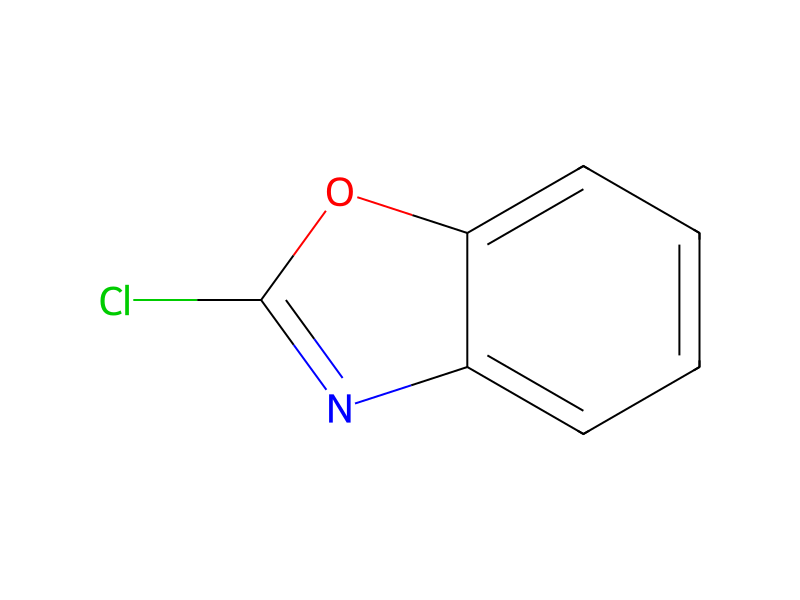

Produkt 1

Reagenzien, Katalysatoren, Lösungsmittel 1

Reaktionsbedingungen
- Temperatur
- 125 °C
Versuchsvorschrift
A mixture of 2-chlorobenzoxazole (0.6 mL, 5.16 mmol) and N-(2-aminoethyl) carbamic acid tert-butyl ester (2.4328 g, 15.18 mmol)) was stirred in a preheated oil bath at 125° C. for 5 h, then held at room temperature overnight. The solidified mixture was dissolved in chloroform (125 mL), washed with aqueous sodium bicarbonate (2×150 mL), then brine (1×150). The organic layer was dried over sodium sulfate, then filtered and concentrated in vacuo. The resulting residue was purified by flash column chromatography, eluting with 60% ethyl acetate in heptane to yield tert-butyl 2-(benzo[d]oxazol-2-ylamino)ethylcarbamate as a beige powder.
Aufarbeitung
- waitheld at room temperature overnight
- washwashed with aqueous sodium bicarbonate (2×150 mL)
- dry with materialThe organic layer was dried over sodium sulfate
- filtrationfiltered
- concentrationconcentrated in vacuo
- customThe resulting residue was purified by flash column chromatography
- washeluting with 60% ethyl acetate in heptane
Quellen und Nachweise
- ORD-Eintrag
- ord-6c940d0472ba490c9940a6b75fb13a00
- Quelldatensatz
- uspto-grants-2013_07
- Patentnummer
- US08481547B2
Notizen zur Reaktion
Wird geladen…