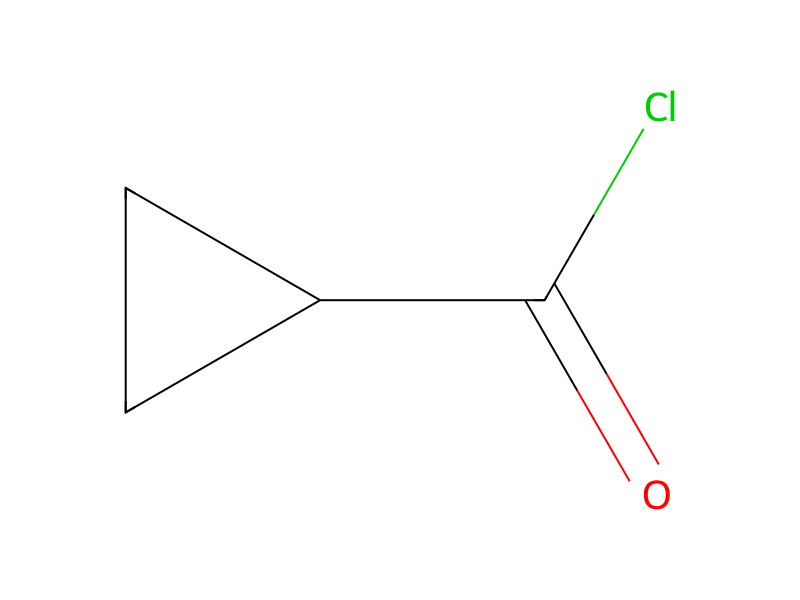
Cyclopropanecarbonyl chloride → HCID 59618057, Verbindung
HRID 449915
Reaktionsgleichung

[NH2:1][C:2]1[CH:7]=[C:6]([NH:8][C:9](=[O:19])[C:10]2[C:15]([Cl:16])=[CH:14][C:13]([Cl:17])=[CH:12][C:11]=2[Cl:18])[CH:5]=[CH:4][N:3]=1.[CH:20]1([C:23](Cl)=[O:24])[CH2:22][CH2:21]1>N1C=CC=CC=1>[Cl:16][C:15]1[CH:14]=[C:13]([Cl:17])[CH:12]=[C:11]([Cl:18])[C:10]=1[C:9]([NH:8][C:6]1[CH:5]=[CH:4][N:3]=[C:2]([NH:1][C:23]([CH:20]2[CH2:22][CH2:21]2)=[O:24])[CH:7]=1)=[O:19]Komponenten
4
Edukt 2

Produkt 1

Reagenzien, Katalysatoren, Lösungsmittel 1

Versuchsvorschrift
To a cooled (0° C.) solution of N-(2-aminopyridin-4-yl)-2,4,6-trichlorobenzamide (82 mg, 0.26 mmol) in pyridine (5 mL) under nitrogen atmosphere was added cyclopropanecarbonyl chloride (41 mg, 0.39 mmol) dropwise. The mixture was allowed to warm to room temperature, stirred overnight, and then quenched with water (15 mL). The reaction was extracted with ethyl acetate (3×10 ml). The combined organic extracts were washed with water (20 mL), dried over Na2SO4 and concentrated under reduced pressure. The residue was purified by prep-HPLC (Gilson GX 281, Shim-pack PRC-ODS 250 mm×20 mm×2, gradient: CH3CN/10 mm/L NH4HCO3, 17 min) to afford the desired product (10 mg, 17% yield). 1H NMR (500 MHz, CDCl3): δ 8.19 (d, J=1.5 Hz, 1H), 8.13 (d, J=6.0 Hz, 1H), 7.52 (s, 2H), 7.49-7.47 (m, 2H) 1.78 (s, 1H), 0.88-0.86 (m, 2H), 0.81-0.78 (m, J=9.5 Hz, 2H). LCMS (ESI) m/z: 367.1 [M+H+].