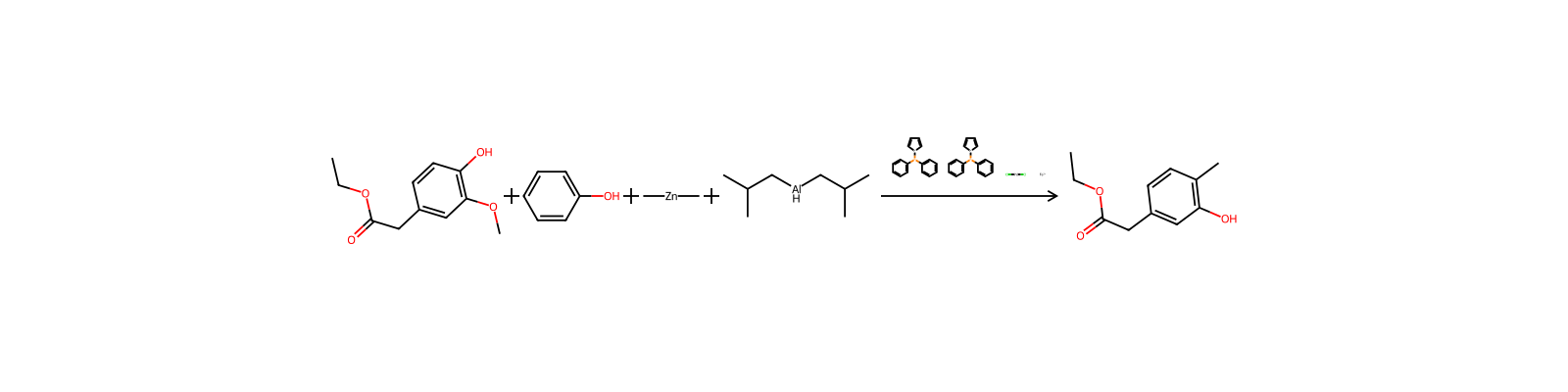
Beteiligte Stoffe
| Rolle | Name | HCID | Einwaage |
|---|
| Edukt | Phenol | HCID 996 | — |
| Edukt | Diisobutylaluminum hydride | HCID 14487 | — |
| Edukt | Ethyl homovanillate | HCID 108965 | — |
| Edukt | HCID 178477796 | HCID 178477796 | — |
| Katalysator | Bis(cyclopenta-1,4-dien-1-yl(diphenyl)phosphane);dichloropalladium;iron(2+) | HCID 178418228 | — |
| Produkt | Ethyl 3-hydroxy-4-methylphenylacetate | HCID 21079755 | — |
Reaktionsschritte
Ethyl 3-hydroxy-4-methylphenylacetate (5a) was prepared from ethyl 3-methoxy-4-hydroxy-phenylacetate as shown in Scheme 2. The phenol was converted to the triflate ester 4b which was subjected to displacement with Me2Zn, DIBAL-H and PdCl2(dppf) (E.-i. Negishi in Metal-catalyzed Cross-Coupling Reactions, F. Diederich and P. J. Stang (eds.), Wiley-VCH, Mannheim 1998, chap. 1; E. Erdik, Tetrahedron 1992 48:9577–9648) to afford the 4c. Boron tribromide demethylation afforded 5a. Ethyl 3-hydroxy-4-ethylphenylacetate 5b was prepared by Friedel-Crafts acylation of 4d which afforded ethyl 4-acetyl-3-methoxyphenylacetate (4e). Reduction of the ketone with triethylsilane and TFA produced the corresponding 4-ethyl substituted derivative 4f which was demethylated with BBr3 to afford 5b. Ethyl 3-hydroxy-4-iso-propylphenylacetate (5c) was prepared by Wittig olefination of 4e and subsequent catalytic hydrogenation of the 2-propenyl substituent to yield 4h. Demethylation with boron tribromide produced 5c.
Herkunft & Nachweise
| DOI | 10.6084/m9.figshare.5104873.v1 |
|---|
| Patentnummer | US07189718B2 |
|---|
| Quelldatensatz | uspto-grants-2007_03 |
|---|
| ORD ID | ord-e818a187292f4f2d896861d76c305d83 |
|---|
| Quellennotiz | uspto-grants-2007_03 |
|---|