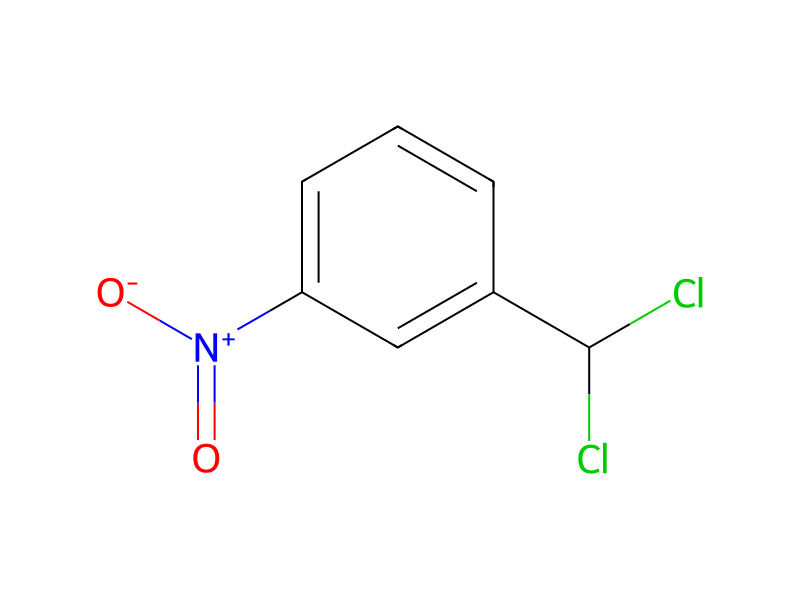
A solution of 32.8 g. of triphenylphosphine in 70 ml. of carbon tetrachloride is stirred for 3 hours at 60° C. to prepare in situ the reagent triphenylphosphine dichloromethylene. A solution of 18.9 g. of 3-nitro benzaldehyde in 60 ml. of carbon tetrachloride is added and the mixture is continued to be stirred at 60° C. for an additional 2 hours, when vapour phase chromatography indicates that all the starting 3-nitrobenzenealdehyde has disappeared and two new peaks in a ratio of 1:1 show the formation of a mixture of ββ-dichloro3-nitrostyrene and 3-nitrobenzalchloride. The reaction mixture is decanted from the solid residues and concentrated in vacuo to an oil. This is treated with ether, and again separated from some solid precipitate and the solution is again concentrated in vacuo. The oily residue is then carefully distilled in high vacuo to give essentially pure β,β-dichloro-3-nitrostyrene.